
Most complex physical systems don't have a single "correct" operating point; they have a tradeoff. Push a variable to improve one outcome and another one often gets worse: cost, safety, throughput, quality. Finding the setpoint that balances those competing demands has traditionally taken deep modeling expertise, a lot of manual tuning, and operator experience built up over years. In this post, we look at what that process looks like when the Dyad Agent is doing the exploring.
Why an Activated Sludge Process (ASP)
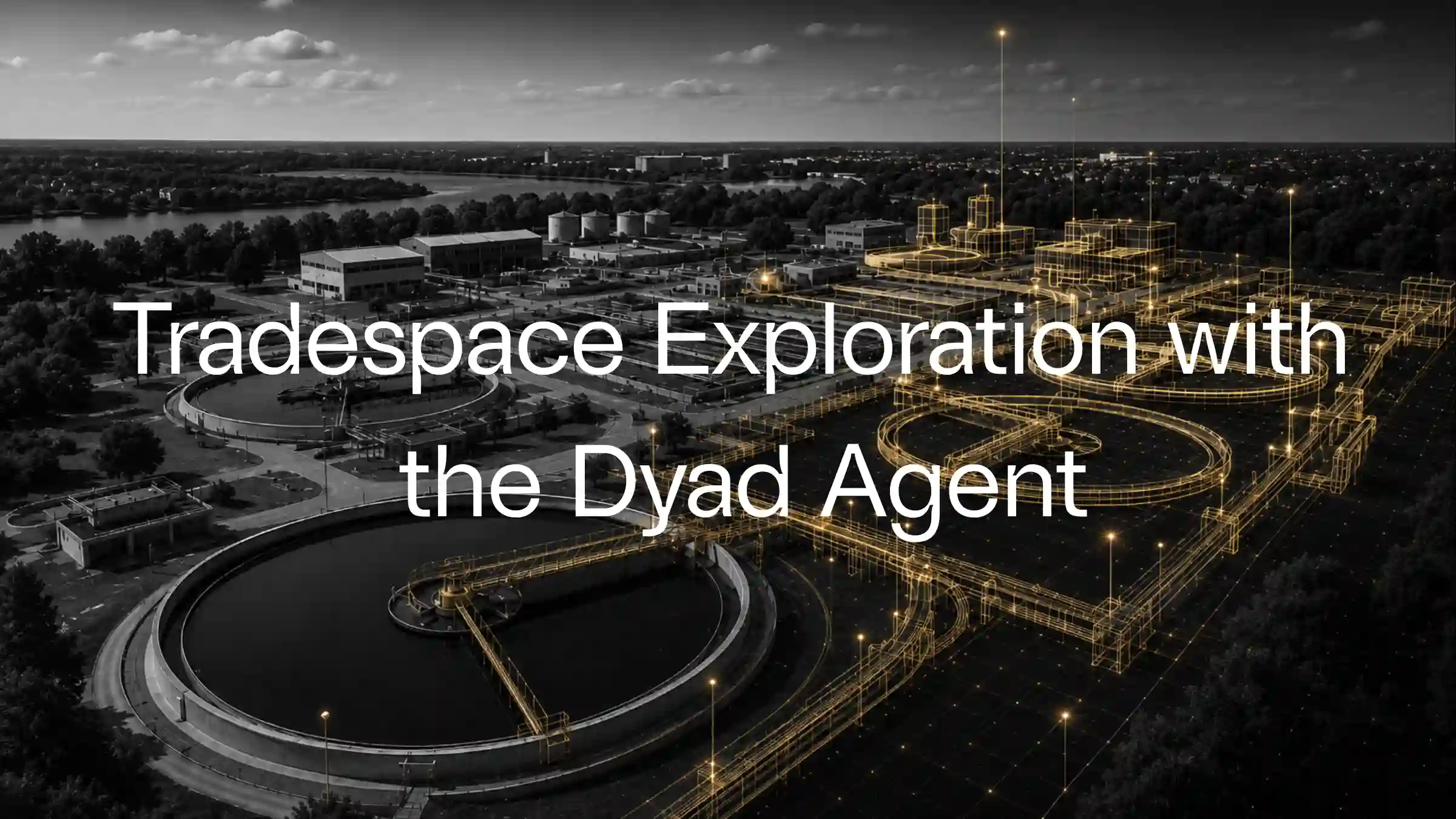
For our working example, we used an ASP - one of the most widely used biological treatment systems in municipal and industrial wastewater management. The core tradeoff is clear and genuinely consequential: aerate too little, and effluent COD (chemical oxygen demand, a standard measure of pollutant load in the water leaving the plant) rises above what regulations allow; aerate too much, and you're burning energy and budget on air the process doesn't need. Every plant operator lives with some version of this balance, which makes it an intuitive way to showcase what agentic simulation actually does.
What the Agent actually does
Working from an existing model, we walked the Dyad Agent through three requests, each given in plain natural language, no scripting or manual file-editing required:
Simulate the baseline model and plot two outputs (aeration rate and effluent COD) to establish a starting point before changing anything.
Modify the model itself. We asked the Agent to add a new top-level parameter for the oxygen setpoint in the model, and to expose that same parameter up in the analysis so it's actually usable at the level where sweeps get run. This is a step above adjusting an existing value; it's editing the model's structure so a new operating variable exists at all.
Sweep the new parameter. With the oxygen setpoint now exposed, we asked for a 3-point sweep and had the Agent return plots of COD and blower flow rate at each setting.
That sweep is really the payoff. Three points is enough to see the shape of the tradeoff: as the oxygen setpoint rises, the blower has to work harder (higher flow rate, more energy) while COD drops (cleaner effluent) - and vice versa in the other direction. Instead of an operator manually testing setpoints one at a time and hoping to stumble onto a good balance, the Agent both built the interface needed to run this study and produced the tradeoff data in a single conversation.
Why This Generalizes
Oxygen setpoint versus COD and blower energy is one specific instance of a pattern that shows up constantly in engineering: modify a model, simulate it, sweep a variable, reevaluate against the tradeoff that matters. Chemical reactors balancing yield against energy use, HVAC systems balancing comfort against consumption, structural designs balancing weight against margin — the shape of the problem repeats even when the physics doesn't. What we're really demonstrating with wastewater is what it looks like to hand that entire loop (i.e. extend the model, run the study, interpret the result) to an agent that can reason about the model in natural language, rather than requiring an engineer to hand-edit the model and hand-script every sweep.
Key Takeaways
How the Dyad Agent extends an existing process model - adding and exposing a new parameter - through natural language
How a small, targeted parameter sweep turns a tradeoff into a decision, rather than a guessing exercise
What agentic, AI-driven tradespace exploration looks like applied to a real-world engineering model
Register for our upcoming webinar on Activated Simulation of the Activated Sludge Process: