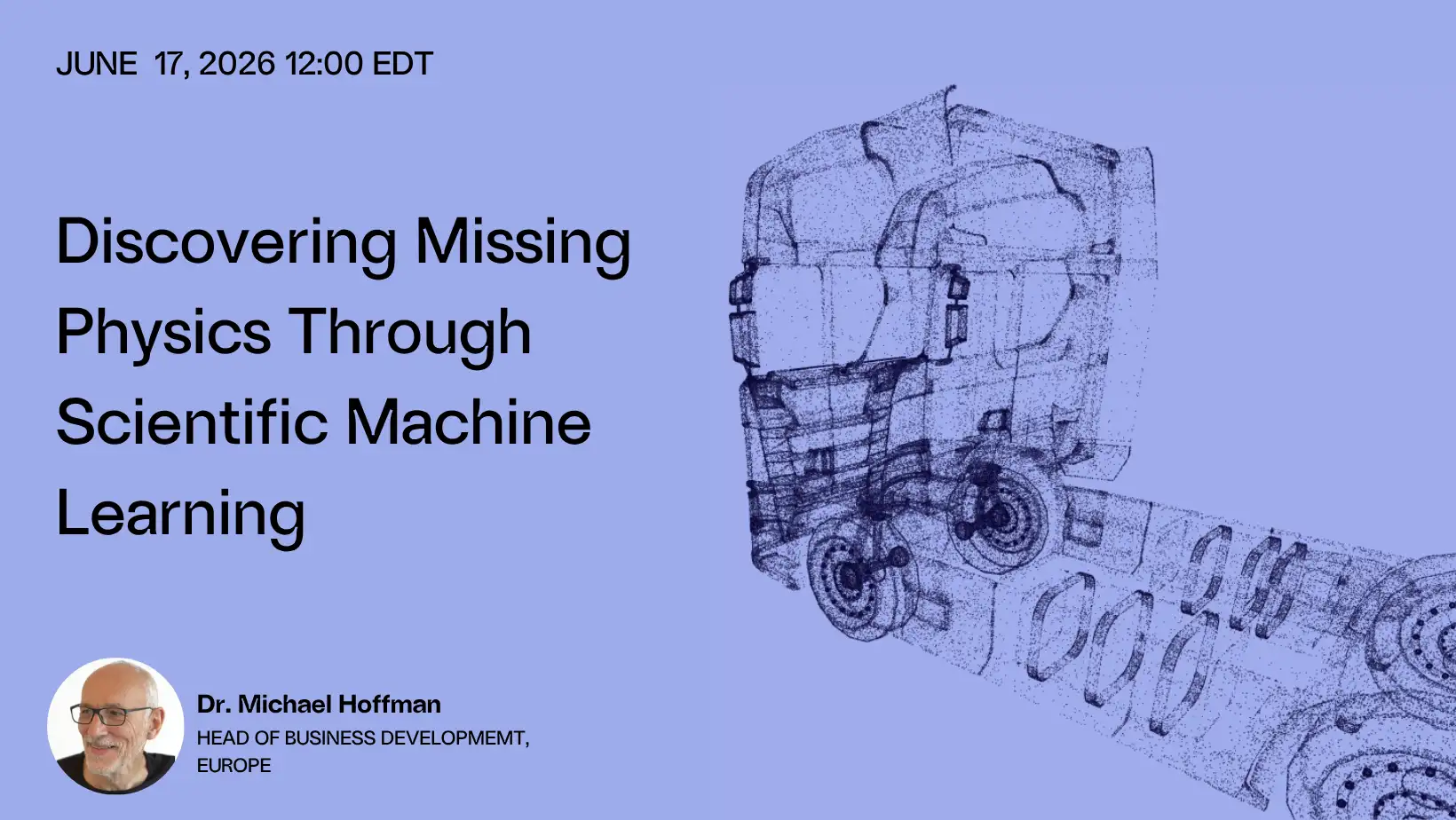
Traditional physics-based simulations are the backbone of vehicle development, yet they often fall short when capturing complex, non-linear behaviors or "missing physics" that aren't easily defined by standard equations. On the other hand, pure Machine Learning (ML) can offer high accuracy but often lacks the robustness and interpretability required for critical engineering decisions.
Join Michael Hoffmann, a veteran with over 30 years of experience in simulation-driven development, as he demonstrates a hybrid approach: Scientific Machine Learning (SciML). Focusing on a Vehicle Ride use case, this webinar explores how to bridge the gap between empirical data and physical principles using Dyad.
We will dive into how engineers can leverage existing test data to refine simulation models, ensuring they remain grounded in physics while gaining the predictive power of modern AI. Whether you are dealing with unknown damping characteristics or complex road-load interactions, this session will show you how to turn raw data into a competitive advantage.
Why You Should Attend
If you are a simulation or test engineer tasked with improving model fidelity, you likely face the "black box" dilemma—choosing between rigid physical models or ungrounded data models. This webinar provides a roadmap for a third way: a unified framework that yields robust, high-fidelity results.
Key Takeaways:
The SciML Fundamentals: Gain a clear, basic understanding of how Scientific Machine Learning differs from traditional AI.
Data-Driven Refinement: Learn practical workflows to use vehicle data to "fill in the blanks" of a simulation model.
Physics-Informed Robustness: Discover how to maintain physical constraints within your models to ensure predictions remain reliable across various operating conditions.
Target Audience
This session is designed for Performance Engineers, Vehicle Dynamics Specialists, and System Simulation Engineers with a basic understanding of simulation technology.
Prerequisites: None. This session is designed to take you from foundational concepts to practical application.