Engineering teams can spend weeks building a simulation before they can use it to answer a design question. Turning documents that consist of reports, schematics and equations into a working model takes engineers’ time, and every day spent creating the initial model adds delays to the development timeline. .
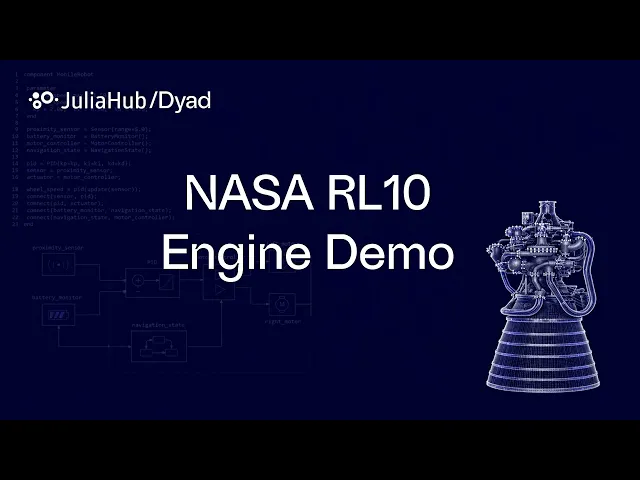
Dyad shortens that model development and calibration work. In this demo, the Dyad Agent builds an RL10 rocket engine model from an extensively detailed NASA requirements document in 8–10 hours, followed by about a day of engineer-led review and refinement.
For engineering teams, this means getting to design answers sooner: testing design alternatives, optimizing design parameters, component changes, comparing results with measured data and investigating system behavior. Engineers guide the work and review the evidence while the agent handles much of the model construction and checking.
Watch the demo to see the workflow, from the first report to the engine simulation and a tested valve rebuild.
Validation: How Accurate Were Dyad's Predictions?
The starting point was a NASA technical memorandum documenting the RL10 rocket engine. The Dyad agent had no existing simulation files, source code, or reusable models to reference. Its only input was a PDF containing pages of technical descriptions, schematics, plots, equations, and design requirements.
After receiving the build task, the agent analyzed the report and developed a plan. An engineer reviewed and approved that plan before the core agent model building began.
Over the next 8–10 hours, the agent built a fluids and media library and used it to construct a baseline engine model. An engineer then spent approximately one day working with the agent to review, refine, and polish the model.
The result was a complete, executable RL10 systems model, built in days rather than the several weeks typically required with conventional modeling workflows.
To evaluate the RL10 model, Dyad's simulation results were compared against NASA's virtual model and measured engine test data across eight tests. The results were encouraging: Dyad's predictions were equal to or better than the actual engine results in seven out of eight tests. The remaining test was an outlier. But, these results were achieved straight out of the box, without any prior model correlation or calibration against the engine test data.
This is significant because conventional model development often involves a substantial calibration effort to align simulation predictions with observed system behaviour. Dyad demonstrated strong predictive performance from its initial model, built directly from NASA's technical documentation.
Rebuilding and Validating Components
Dyad's capabilities extend beyond building complete systems models. Its AI agent can also modify individual components, reconstruct their behaviour from technical documentation, and verify that they meet specified engineering requirements.
In the RL10 demonstration, the agent was asked to rebuild the mixture ratio valve (MRV) using only its interface and the information available in NASA's report. The interface provided the input, output, and parameter names, but no equations or implementation details.
The agent interpreted the relevant specifications and reconstructed the valve's behavior, including NASA's pressure-area relationship and a movement-rate limit of 10 strokes per second.
It then verified the implementation against these requirements. All 199 existing model tests passed, and simulation results confirmed that the valve followed the specified pressure-area relationship without exceeding the movement-rate limit.
The agent also documented its implementation decisions and cited the relevant pages of the NASA report, allowing engineers to trace the model back to its source documentation.
The Result: From Technical Documentation to a Validated Engineering Model
The RL10 demonstration showcases how Dyad brings together AI-assisted model development, engineering expertise, and simulation-based validation.Starting with a single NASA technical report, Dyad built a complete rocket engine systems model in hours, followed by engineering review and refinement over approximately one day. Its predictions matched or outperformed actual engine results in seven of eight tests, without prior correlation, and its AI agent successfully rebuilt and validated individual components against documented engineering requirements.
With Dyad, engineers can move from technical specifications to high-fidelity, executable systems models in days instead of weeks, accelerating the model-based engineering process.