
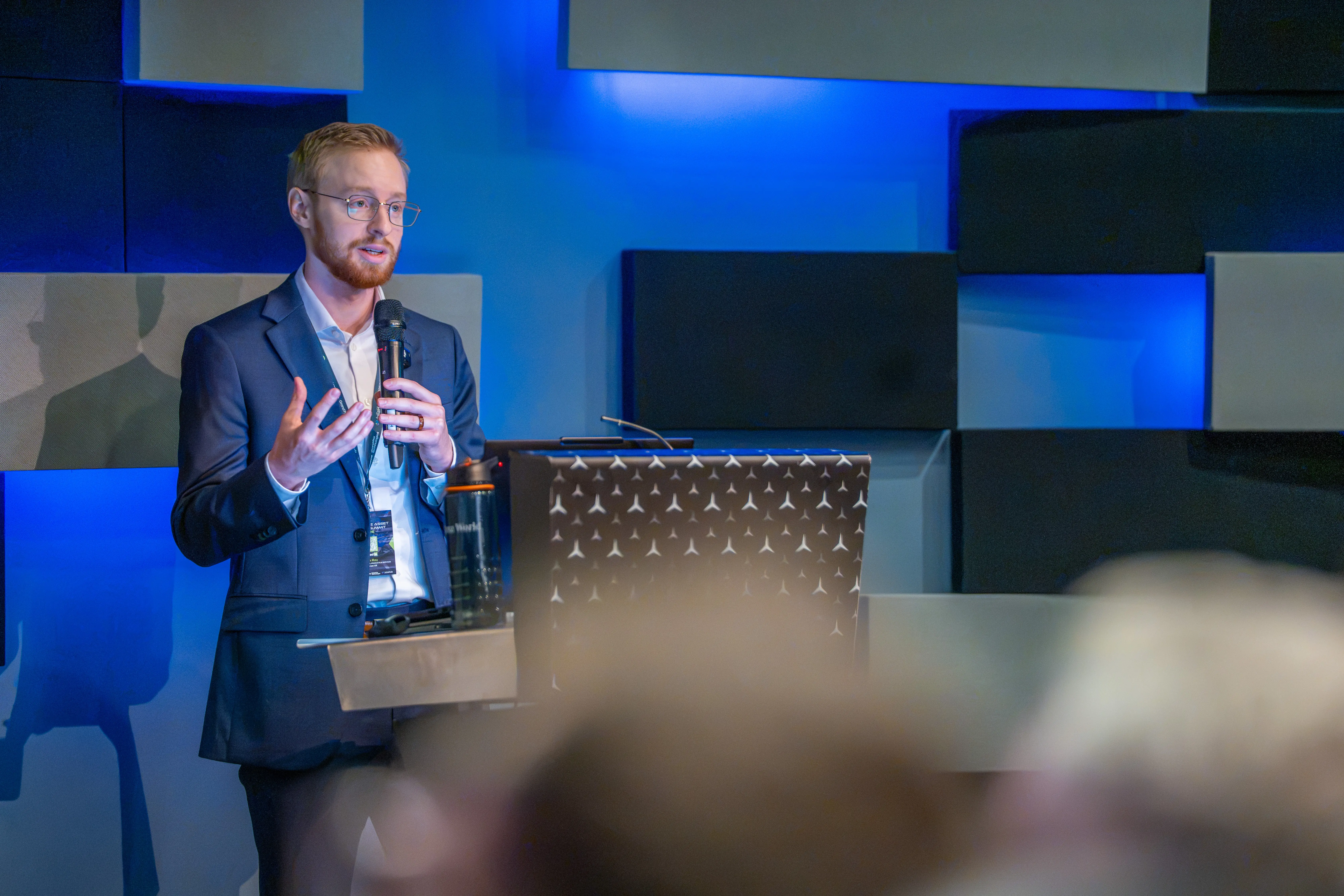
At the recent Water Asset Health Summit 2026, hosted by Binnies I spoke about a methodology that bridges the high performance requirements of Formula 1 with the reliability and transparency of the water industry.
In particular, the events carrying most of our risk or expense are often exactly the ones we have the least data on. A critical pump failure, a burst pipe, or a sudden change in water quality may be rare, but the cost is high.
My talk, “AI from F1: Asset Health Case Study,” explored how the methodology of scientific machine learning (SciML) transits from F1 to enable engineers in the water sector with powerful, interpretable models that shift maintenance from reactive to predictive.
What water utilities can learn from F1
F1 teams are in a constant battle to reduce weight and improve aerodynamics – sensors are simultaneously vital, yet almost always work in direct contrast to these goals. We worked with Williams Racing to explore the viability of substituting a model in place of their velocity over ground sensor.
The approach needed to be trustable; that is, both accurate and interpretable. To achieve this, we combined the known physics of the car, supplemented with data-driven methods. Put simply, we start with stuff we already know and use machine learning to fill in the gaps.
Water utilities have the same challenge. It is not practical to put a sensor on every part of every asset. Therefore, we need a solution to reliably estimate what we cannot measure directly.
The challenge is in handling rare events
Most operational data describes normal days. Black-box models will fit this data well, and likely will perform well only while conditions stay in nominal operation.
Unfortunately, nominal operation is when the models are the least useful.
What happens when conditions change? How does it respond before a pump fails? What happens during an unusual inflow event? Can it help when there are few examples of the problem in the data?
Physics gives us a starting point. Engineers already understand a great deal about pumps, pipes, motors, and treatment processes. Scientific machine learning, or SciML, combines that knowledge with data.
So we start with a model of how the system works. We tune its parameters using the measurements available. Where the model still misses part of the behaviour, we can add a learned component.
The structured physics allows generalization outside the historical record. Of course, we still need to test the model and understand its limits.
A model has to earn trust
Imagine a model raises a pump alarm at three in the morning. The gauges look normal. The operator needs interpretability in order to react. “The AI said so” is never enough.
A useful model should provide information the operator needs and recognizes to act further. It could be anything from a change in friction, to hydraulic efficiency, or pump performance. The model should also show how uncertain its estimates are.
At JuliaHub, our work combines engineering expertise, component-based models, and data-driven methods. In this arena, component-based modeling allows us to efficiently construct interconnected models of individual pumps, pipes, and motors into a holistic model of the wider system. Building it still requires an understanding of the site, careful calibration, and validation. While an AI agent can help with parts of that work, it is engineering judgment that makes the result useful.
Applying the approach to water systems
We showed two different pilots of the methodology: clean water and sewage pumping stations. For our clean-water pilot, we used pressure, flow, and electrical current measurements to estimate hidden aspects of pump health. The model provided virtual measurements of mechanical and hydraulic efficiency, and identified an inefficient operating setpoint.
This feasibility study showed how existing data streams can support maintenance and operating decisions without expensive outlays of new sensors.
For sewage pumping stations, I demonstrated a digital twin replaying recorded telemetry: using rainfall, level, pressure, and flow data, we examined a wide range of changing conditions, including a pressure sensor fault, a rising-main burst, and an inflow blockage.
We are very excited to be partnering with Binnies to apply SciML to activated sludge processes where our work aims to reduce nitrous oxide emissions. In order to do that, the model first needs to estimate what is happening inside the treatment process. The assets differ, but the principle stays the same: use engineering knowledge and the data available to understand more of the system.
The question I left with the audience
I enjoyed sharing these examples with the water community at Binnies. Our work spans different industries, but the need for understandable, useful models is common to all of them. For example, we worked with Mitsubishi Electric Research Laboratories to improve HVAC diagnostics, using an innovative approach for refrigerant mass estimation in heat pumps and air conditioners.
The question I left with the audience was simple:
What does your model do on the day it has never seen?
That is a question worth asking before any AI pilot becomes part of an operational decision.