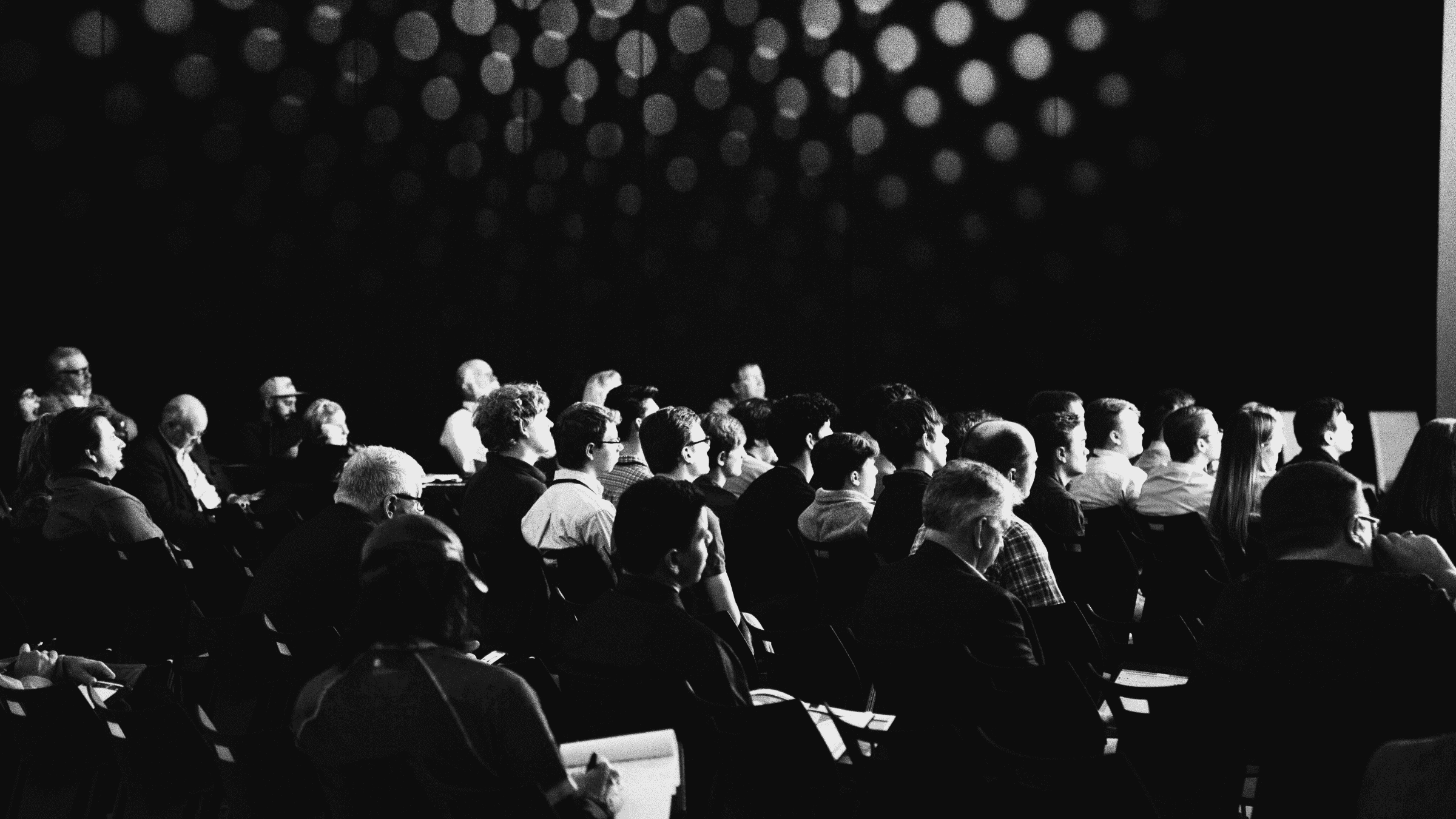
AIAA SciTech Forum is the world’s largest event for aerospace research, development, and technology. Each year the event brings together a global community of academic, industry, and government professionals in the civil, commercial, and national security sectors, along with leaders from adjacent industries, to address challenges and technical opportunities. JuliaHub recently participated in the event, where the response at our booth was nothing short of energizing. With heavy footfall throughout the event, the conference proved to be a strong forum for conversations around AI-driven engineering, modeling, and simulation.
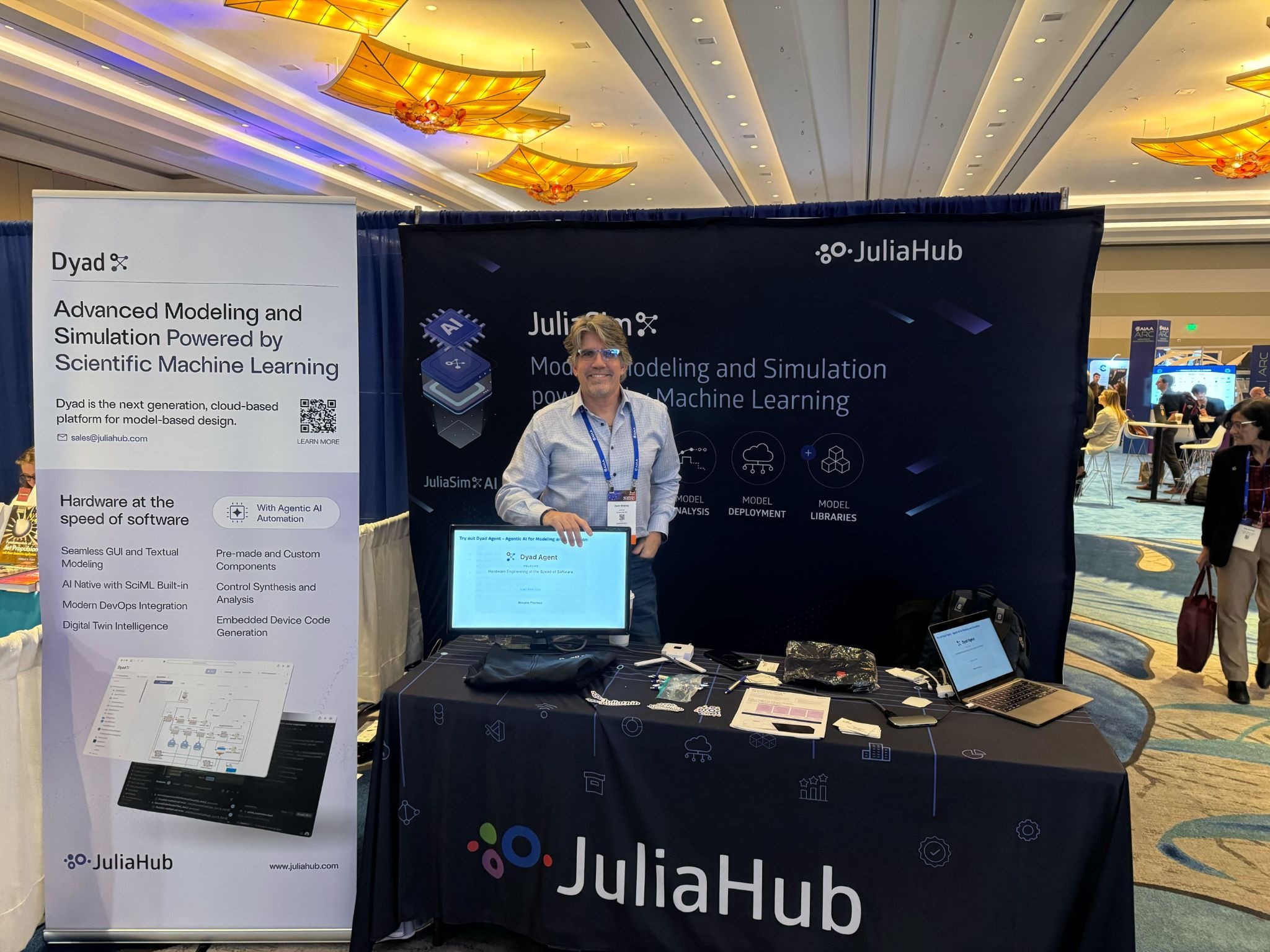
Bringing Dyad’s AI Agent to Life
One of the highlights of this event was JuliaHub’s demonstration of the Dyad AI agent in action, showing how engineers and scientists can interact with complex models through natural language while retaining full transparency and scientific rigor.
Instead of static demos, our team explored a wide range of real engineering and scientific models, showcasing Dyad’s strengths in exploratory analysis, rapid iteration, and decision-making across domains.
Models Demonstrated at the Booth
Visitors engaged hands-on with Dyad-powered workflows covering:
Fixed-wing UAVs and mission design
Exploring flight dynamics, mission profiles, and design trade-offs.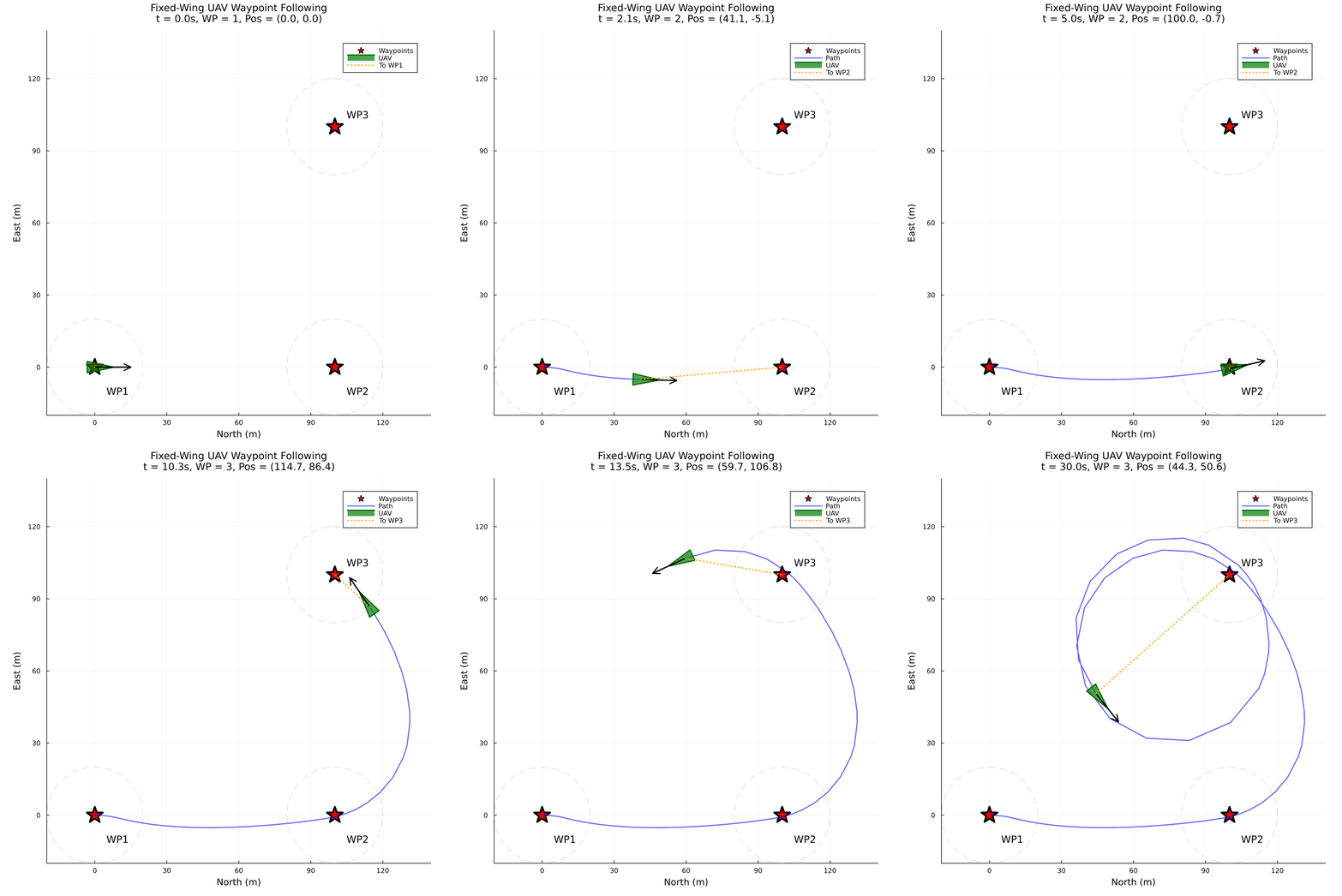
Jet engines (JetCat and LEAP)
Interacting with propulsion models to analyze performance characteristics and operational behavior.Conceptual aircraft models
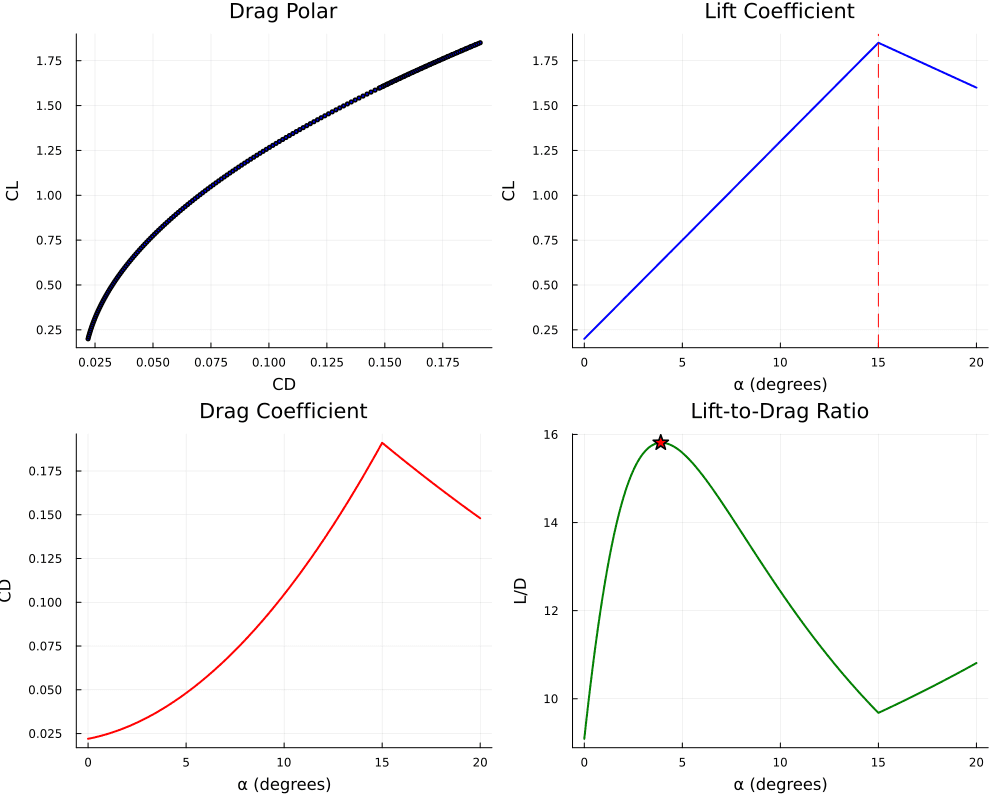
Analyzing lift and drag coefficients versus angle of attack, highlighting how Dyad enables rapid aerodynamic exploration.
Human performance models of pilots
Demonstrating how physiological and cognitive factors can be incorporated into system-level simulations.Fluid mechanics and pipe flow
Solving and inspecting classical flow problems to show Dyad’s applicability beyond aerospace.
These examples sparked thoughtful discussions with attendees about digital twins, system-level modeling, and AI-assisted engineering workflows, especially in contexts where trust, interpretability, and physical correctness matter.
The consistent footfall at the JuliaHub booth reflects a growing interest in Scientific Machine Learning (SciML) and AI systems that work with physics-based models rather than replacing them. Many conversations were centered on how Dyad fits into existing engineering workflows and how organizations can move from experimentation to deployment.
Looking Ahead
AIAA was a strong reminder that the demand for trustworthy, interactive, and scalable modeling tools is only increasing. We’re excited by the interest and look forward to continuing these conversations, both online and at upcoming events.
Interested in seeing Dyad in action or exploring how JuliaHub can support your modeling and simulation needs? Get in touch with our team to learn more.