Hands-on Modeling Workflows for Complex Engineering Systems Europe Series - Nuremberg
Join us in Nuremberg on Friday, March 20, for a hands-on engineering seminar on modern modeling and simulation workflows. Discover a new approach to system design with Dyad, an AI-native modeling and simulation platform. The session will explore how agentic intelligence, symbolic modeling, and Scientific Machine Learning (SciML) can help address complex engineering challenges. Due to limited seating, email confirmation is required to reserve your place.
Event Details
Date: Friday, March 20
Location: Nuremberg
Time: 10:00–14:00 (followed by open discussion)
Hands-on Modeling Workflows for Complex Engineering Systems Europe Series - Grove
Join us in Grove, Oxfordshire on Friday, March 27, at the iconic Williams Racing campus for a hands-on engineering seminar focused on modern modeling and simulation workflows. Learn a new approach to system design using Dyad, an AI-native modeling and simulation platform. Explore how agentic intelligence, symbolic modeling, and Scientific Machine Learning (SciML) can tackle the most complex engineering bottlenecks. Register here.Dyad 2.0: What Agentic AI means for the Future of Computer Languages
Event Details
Date: Friday, March 27
Location: Grove, Oxfordshire, Williams Racing campus
Time: 10:00–14:00 (followed by open discussion)
Dyad 2.0: What Agentic AI means for the Future of Computer Languages
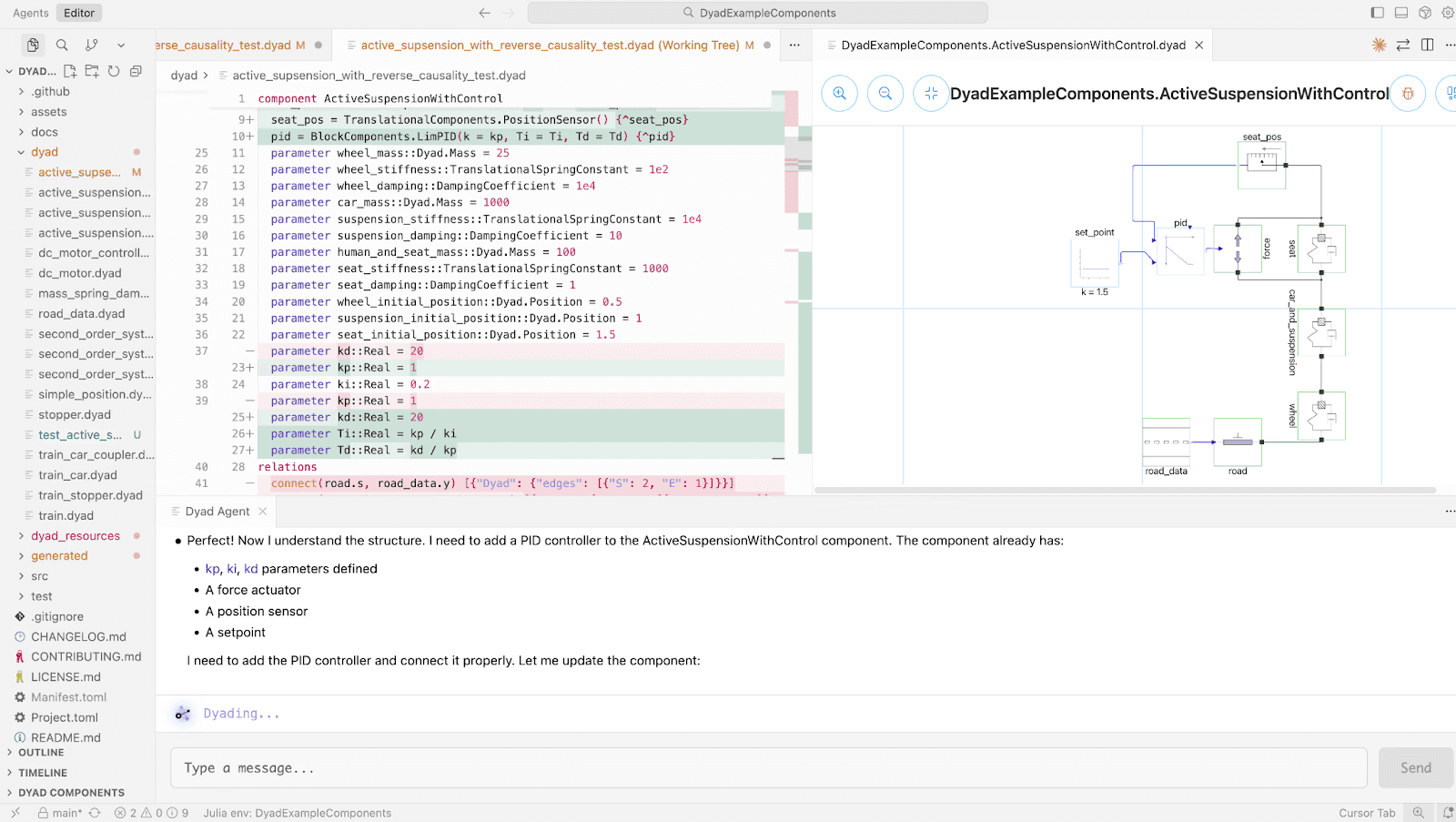
Dyad 2.0 introduces an AI-first, agentic workflow designed specifically for modeling and simulation. Instead of treating AI as a coding assistant, Dyad rethinks the language itself, optimizing for how agentic systems reason, generate, and refine engineering models. With its terse, equation-based design and strong compiler feedback, Dyad enables higher accuracy, faster iteration, and more reliable AI-driven model construction. The result is a system where engineers define the physics, and the agentic AI handles exploration, validation, and implementation.
Press Release: JuliaHub Launches Dyad AI: The First Agentic Engineering Platform Built for Real-World Physics
We are thrilled to announce the official launch of Dyad AI. In this press release, we share why this is an important milestone and how AI for Science is moving, by collaborating with engineers on models, behavior, and validation to close the loop between intent and verified performance. Read the full press release.
Join Dyad Modeling Live
Build models live with Chris Rackauckas using Dyad and Agentic AI. Follow Chris @ChrisRackauckas Twitch, to get notified when the next interactive session begins, watch, ask questions, or even model alongside him. Watch our recent series of livestream episodes where we build a quadcopter live.
Agentic AI Transforms Hardware Engineering by Automating Model Construction & Validation
JuliaHub co-founder and CEO Viral B. Shah writes this thought provoking article for Design News that looks at how agentic AI can automate model construction, parameterization, and validation, while preserving the rigor of physics-based engineering. The article explores the potential of platforms like Dyad that treats models as structured, physics-aware objects, allowing AI agents to handle repetitive, error-prone setup work so engineers can focus on judgment, tradeoffs, and system design. Read more
JuliaHub Featured in Machine Design Magazine
Machine Design recently featured an in-depth article by Brad Carman, Director of Consulting Services at JuliaHub, exploring how Scientific Machine Learning (SciML) is advancing predictive asset maintenance and optimization across modern manufacturing environments.
A “Who’s Who” Guide to Battery Modeling Software
Following the Volta Foundation 2025 Annual Battery Report, two of the contributors Daniel Cogswell and Andrew Weng released a companion guide comparing leading battery modeling tools.
Part 2 highlights Dyad Batteries, built on the physics-based Doyle–Fuller–Newman (DFN) model within the Julia ecosystem. Fully compatible with Julia’s ML and optimization libraries and available via the JuliaHub Cloud, Dyad Batteries stands out for its speed, solving DFN models in milliseconds, making high-fidelity battery simulation more scalable and practical.
Webinar: The Two Fundamental Paradigms of System Modeling, Mar 11, 1:00 PM EDT
This webinar takes a look at the two fundamental paradigms of system modeling: a declarative acausal paradigm to design plant models and causal components used to define control systems. We cover the use cases for both causal and acausal paradigms, the advantages of both, and how they can co-exist in the Dyad modeling environment. Register here.
Webinar: Julia for Engineers Part 2: Modeling Steady-State and Dynamic Systems, Mar 18, 1:00 PM EDT
Part 2 of the series explores how to model, simulate and analyze both steady-state and dynamic systems using Dyad. We show how to build models that capture both equilibrium conditions and time-dependent behavior, sharing insights into system performance under varying conditions. Register here.