What I learned from my first 50 days with JuliaHub
The first 50 days at a new company are usually a whirlwind of setup scripts and coffee chats. But at JuliaHub, my first 50 days were defined by something else: listening.
After dozens of deep dives with engineers, data scientists, and systems architects, a pattern began to emerge. These "early adopters" weren't just looking for another library or a slightly faster compiler. They were looking for a fundamental shift in how they build complex systems.
When I asked them why they were making the jump to Dyad, their answers consistently fell into three categories.
One Integrated Tool: Ending the "Tooling Tax"
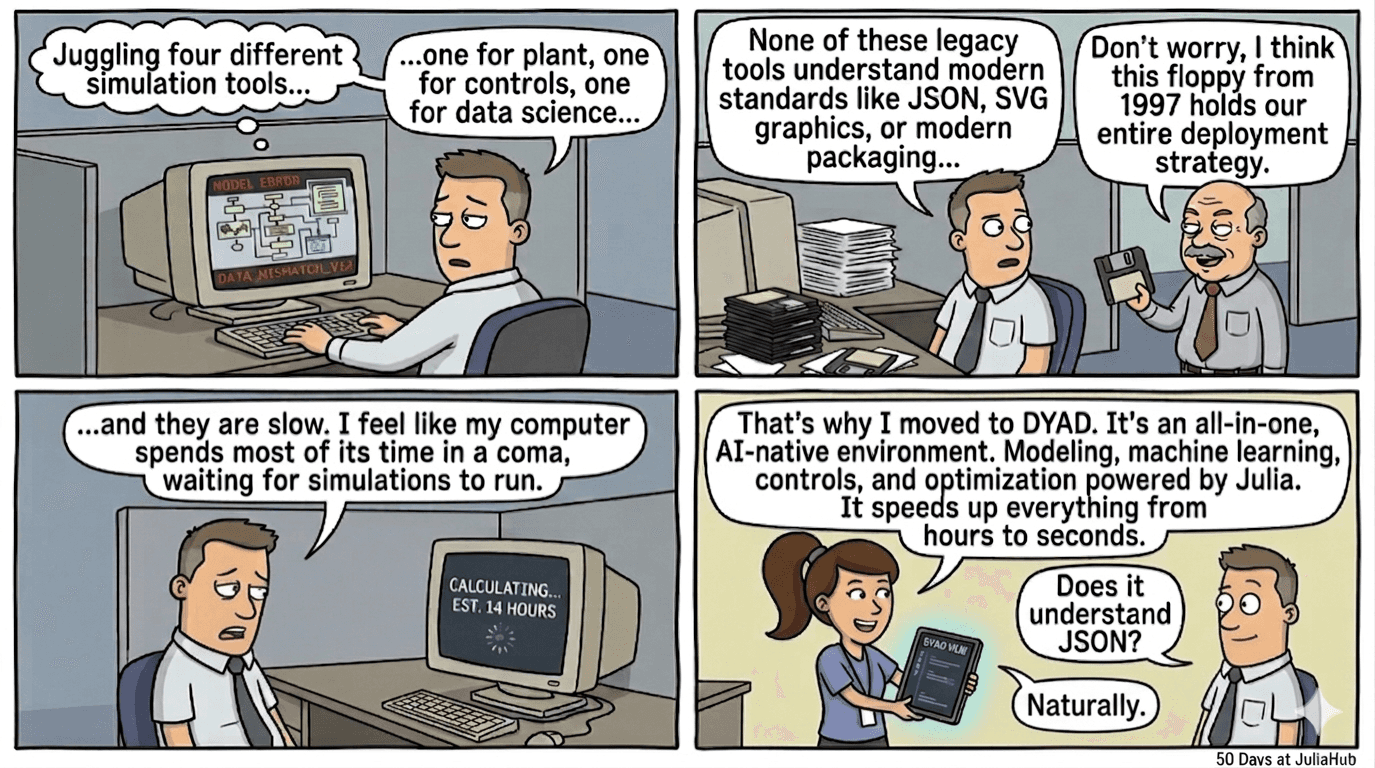
In most engineering departments, the common practice involves a fragmented ecosystem. I’ve spoken to teams where engineers are forced to juggle various tools: one for plant modeling, another for controls, a third for machine learning, and potentially another for process automation.
Every time a model moves between these "silos," data is lost, errors are introduced, and time is wasted. Dyad does all of this in one environment, providing a seamless workflow that allows you to:
Build with Efficiency: Construct physical models with minimal code.
Bridge the Gaps: Discover missing physics through machine learning directly within your model.
Scale & Accelerate: Turn models into high-performance Digital Twins and create surrogates to accelerate simulations from hours to milliseconds.
Deploy: Build and deploy robust controls without ever leaving the ecosystem.
AI-Native Tool: Beyond Simple Autocomplete
While much of the industry is "bolting on" AI as a sidecar or a chat interface, Dyad was built with an AI-native philosophy. Having one tool with a common language is just the baseline for what an AI-native tool should be.
The Dyad agent doesn’t just generate a few models and leave the heavy lifting of validation to the user. Instead, it acts as a true collaborator:
Creation & Validation: It creates and validates individual components.
System Assembly: It assembles those components into complex systems and validates them again at the system level.
Deep Analysis: The agent runs simulations and assesses the results for physical plausibility, ensuring the output isn't just mathematically possible, but engineering-sound.
A Modern Tool: Leaving the 90s Behind
It is a bold claim to say a tool is built for the next 50 years—technology moves too fast for that. However, it is very easy to see which tools are stuck in the past. Most legacy engineering platforms were architected in the 90s and early 2000s, and it shows.
Early adopters are moving to Dyad because they are tired of fighting against software that hasn't kept pace with the modern web and data stack:
Web-Standard Native: Many legacy tools still don't know what a JSON file is or lack built-in support for modern SVG graphics. Dyad treats these as first-class citizens.
Modern Product Packaging: From deployment to versioning, Dyad utilizes modern packaging standards that make sharing and scaling models as easy as shipping a modern web app.
The Power of Julia: Perhaps most importantly, legacy tools don't leverage the power of Julia. Dyad solves the "two-language problem" by giving you a high-level syntax that achieves C-level performance, allowing for real-time interactivity that 20-year-old architectures simply cannot match.
"We didn't just need a faster solver; we needed a smarter way to connect our physics to our data. Dyad was the first tool that didn't feel like it was fighting our workflow."
— Overheard during a Week 4 Customer Deep-Dive
The Road Ahead
My first 50 days have shown me that the move to Dyad is a migration towards efficiency. Engineers are tired of "good enough" legacy software from a previous era. They want tools that speak the language of the modern world.
If you’re tired of juggling disconnected licenses and fighting with tools that don't understand modern data formats, it might be time to see what the Dyad ecosystem can do for your team.
What does your current "tooling tax" look like, and how much time could you save by moving your workflow into the modern era?
A Parting Thought...
I’ve definitely been the guy in the first panel.
Not anymore. :-)