
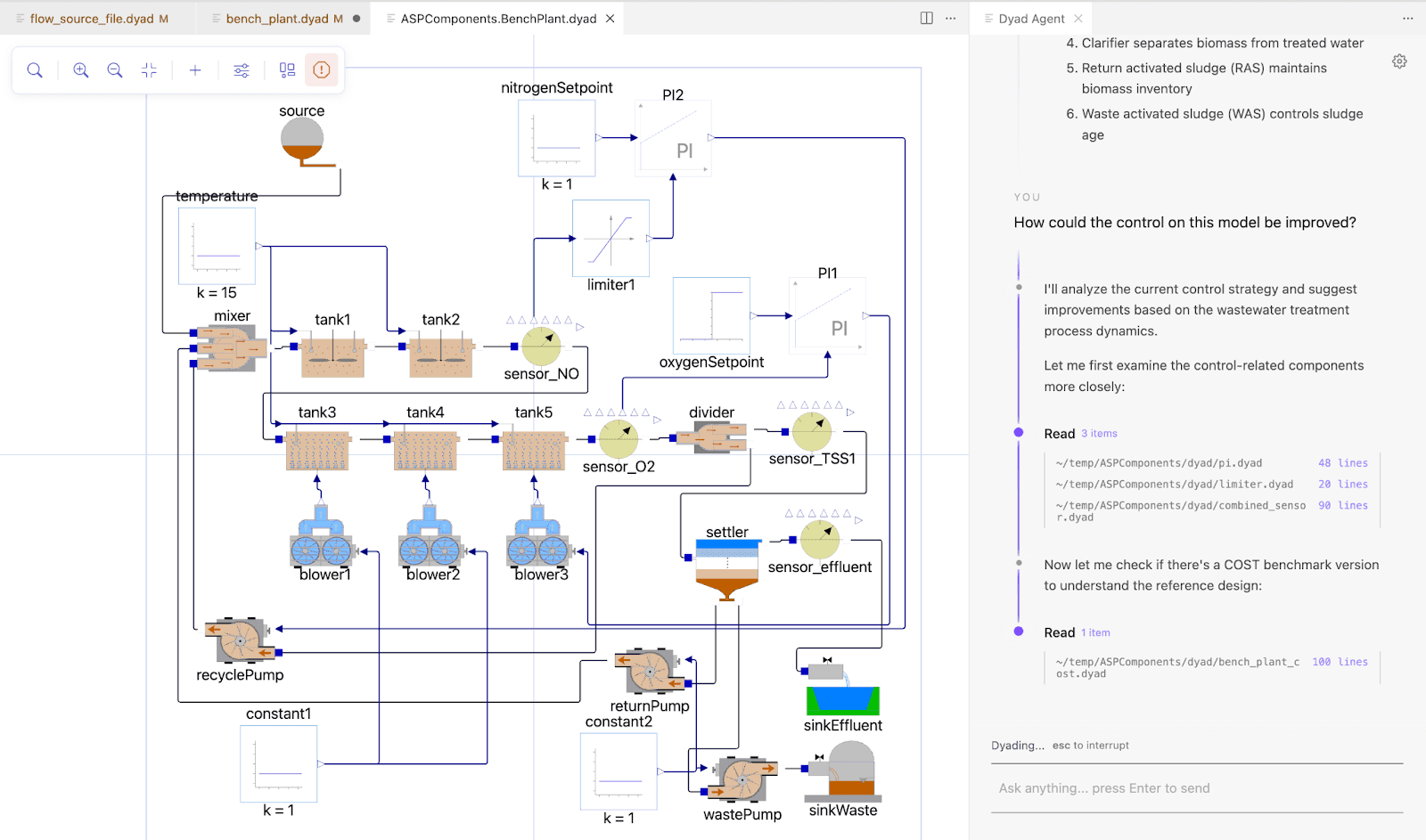
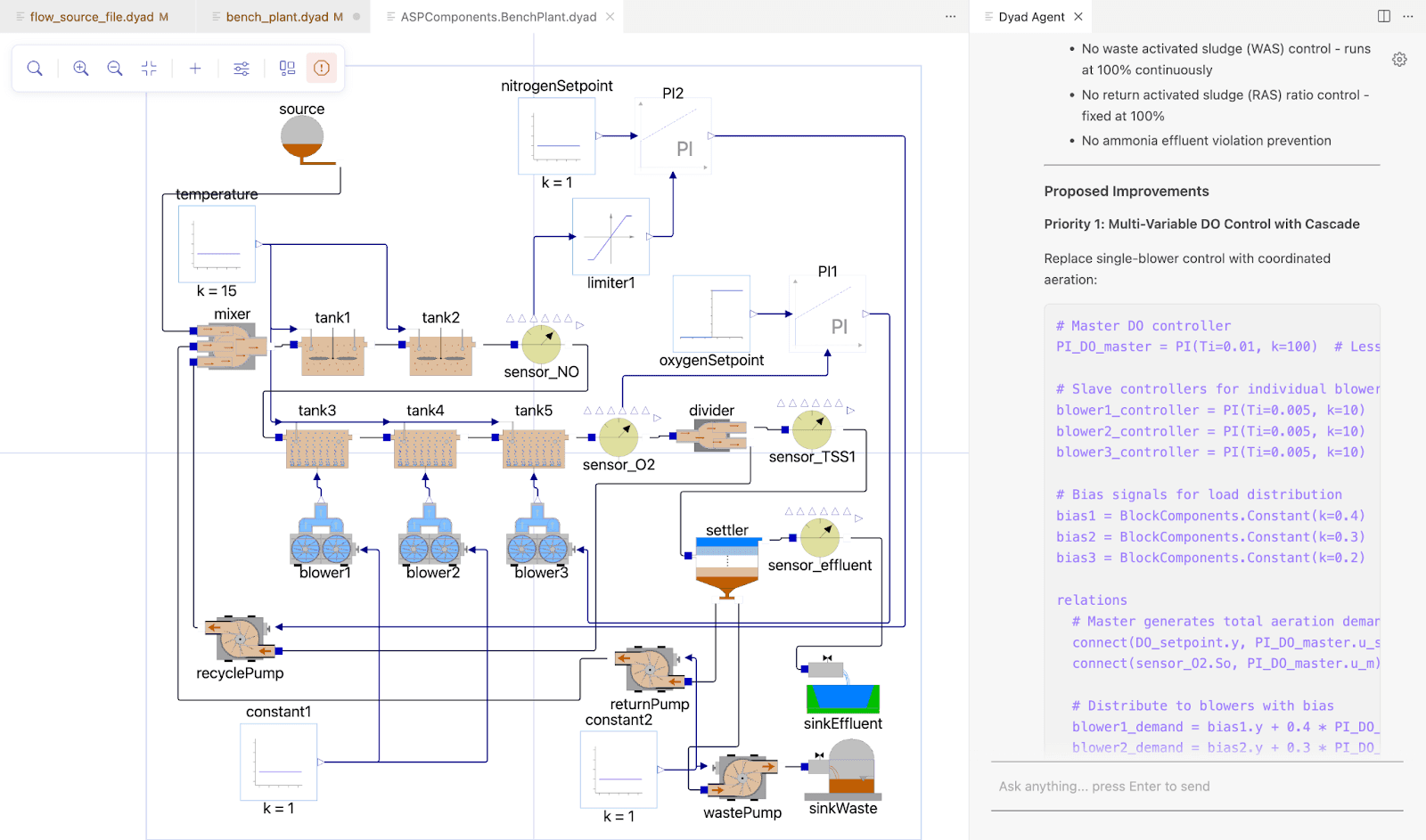
Announcing Dyad v.2.0 with Powerful Agentic AI Capabilities: JuliaHub is thrilled to announce the upcoming release of Dyad v2.0.0. The new release brings agentic AI and simulation together in a seamless environment, enabling models to act as interactive collaborators that propose formulations, generate experiments, test hypotheses, and autonomously refine results. By closing the loop between reasoning and simulation, Dyad accelerates engineering workflows and supports verified model development rather than manual trial-and-error. This is a major step toward AI-assisted modeling workflows. This release also introduces Dyad’s graphical interface, providing an intuitive user experience that supports both exploratory modeling and scalable engineering workflows.
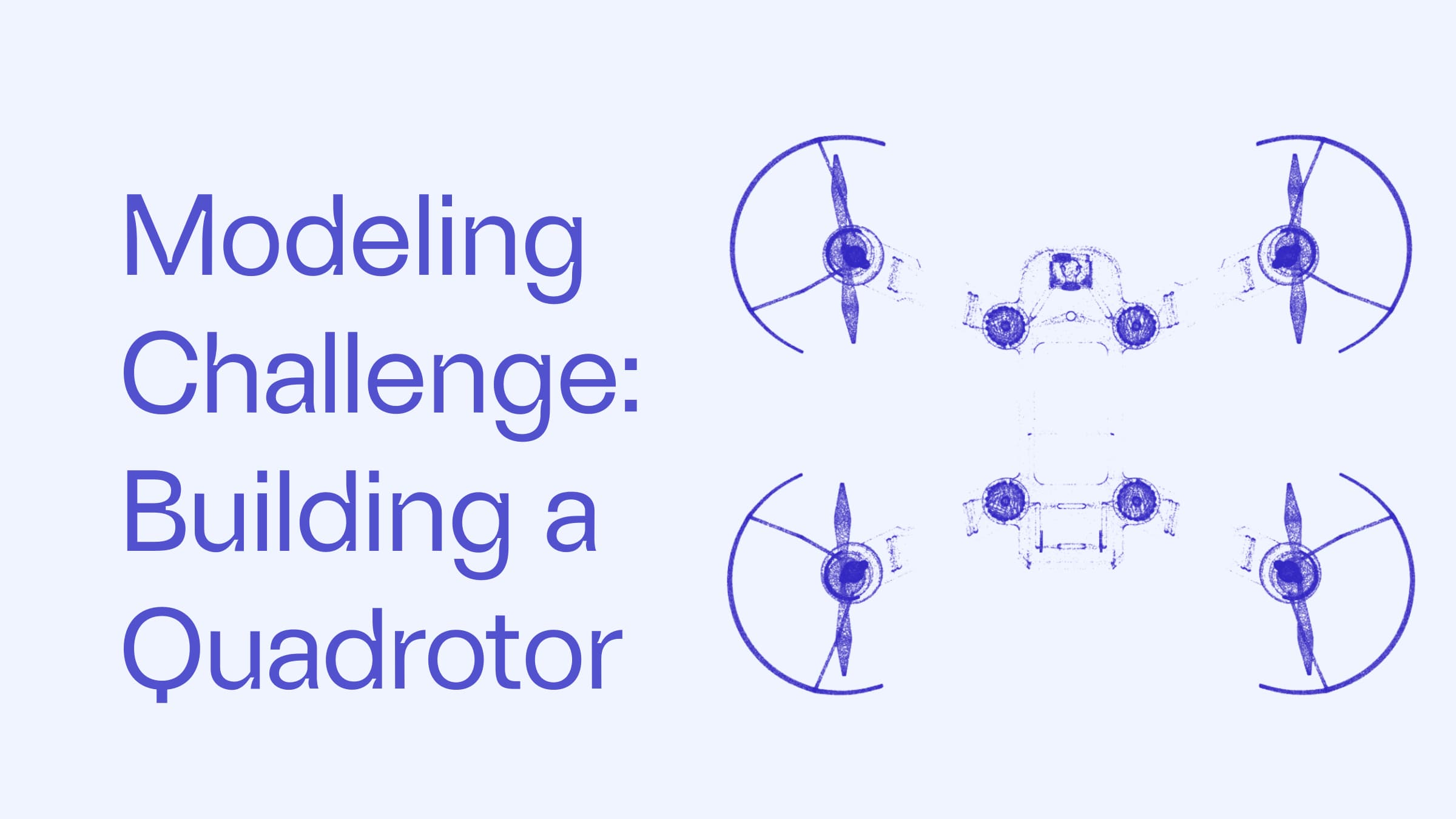
Agentic Dyad AI Modeling Livestreaming — Building a Quadrotor Model: Join our new weekly livestream where Dr. Chris Rackauckas builds real-world models with Dyad’s agentic AI. Participants can bring their own challenge and watch models come together live, showcasing rapid model generation, iteration, and validation. Streaming every Friday at 10am EST on JuliaHub YouTube and @ChrisRackauckas Twitch, the series creates an open lab for engineers and researchers to explore agentic simulation firsthand. Watch the latest episode where we built a quadrotor model.
Free Online Julia Webinars from JuliaHub: JuliaHub provides free one-hour Webinars led by JuliaHub staff and other experts. Space is limited and registration is required, so please sign up today!
Interactive Dashboards with Dyad and Makie.jl with JuliaHub Software Engineer Anshul Singhvi, Thursday January 22, 1-2 PM Eastern(US)
Meet the Dyad Agent: An Agentic AI for Model-Based Engineering with JuliaHub Sales Engineer David Dinh, Wednesday January 28, 1-2 PM Eastern(US)
Recent JuliaHub Webinars: JuliaHub provides free one-hour Webinars on topics of interest to Julia users. Nearly 100 past Webinars are available online. Click here to watch.
This Month in Julia World: This Month in Julia World is a newsletter from Stefan Krastanov with up-to-date information about Julia events, new releases and more. Read it here.
Nouvelles Julia - Julia News en Français: Nouvelles Julia is a newsletter in French with the latest Julia news. Read it here.
Rebuilding the Simulation Stack for AI: Dr. Viral B.Shah and Dr. Chris Rackauckas discuss how engineering simulation is being rebuilt from the ground up in the State of Simulation podcast. They explore modern solver stacks, combining physics with data through SciML, enabling realistic digital twins, and how AI-powered hybrid physics–ML models are reshaping industrial engineering. Watch the full conversation here.
Dependabot Now Supports Julia: Dependabot now works with Julia packages, making it easy to automatically keep your project dependencies up to date with the latest releases. Developers can now use Dependabot version updates to reduce manual maintenance, improve security, and avoid dependency drift in Julia projects. Find out more.
JuliaCon Global 2026 — Call for Proposals Deadline: The Call for Proposals for JuliaCon Global 2026 is now open and closes on Feb 28, 2026 (23:59 CET). JuliaCon Global 2026 will take place in person in Mainz, Germany, from August 10–15, 2026. Talks will span beginner to advanced topics across industry and academia, offering a global stage to share your work with the Julia community. Submit your proposal here.
ClimaLand: A Land Surface Model Designed to Enable Data-Driven Parameterizations: A new paper discussing the first release of ClimaLand, developed by the Climate Modeling Alliance (CliMA), introduces a next-generation land model built from the ground up in Julia. With a modular architecture and GPU-native execution, ClimaLand makes it easier to simulate, calibrate, and quantify uncertainty in land processes and to integrate machine learning and hybrid physics–ML models into Earth system workflows. Find out more.
Julia4PDEs-2026: A 2-day workshop bringing together the Julia community working on partial differential equations (PDEs) will take place on March 26–27, 2026 at Vrije Universiteit Amsterdam. The event will feature keynotes from projects like Ferrite.jl, Gridap.jl, Trixi.jl, WaterLily.jl, and more, along with a hands-on demo of GalerkinToolkit.jl, a new multi-platform finite element library for Julia. Register here.
Physics-Informed Neural Surrogates for Mesh-Invariant Modeling of High-Speed Flows: A new neural surrogate model can predict high-speed aerodynamics up to 595× faster than CFD while maintaining about 1% relative error, enabling rapid design exploration and real-time decision-making.The approach combines mesh-invariant neural architectures, physics-embedded formulations for guaranteed mass conservation, and compiler-level optimization using Reactant.jl, Lux.jl, and EnzymeMLIR for faster training and inference. The model has been validated on hypersonic cone and waverider geometries across a wide range of Mach numbers and altitudes. Find out more.
New Blog Posts from SciML: SciML has published several new blog posts. You can read them here.
New Blog Posts from Dr. Chris Rackauckas and Great Lakes Consulting: Several new blog posts have been published by JuliaHub VP of Modeling and Simulation Dr. Chris Rackauckas and Great Lakes Consulting Senior Julia Developer Steven Whitaker.
Julia Dispatch Podcast: Julia Dispatch is a Julia podcast from Dr. Chris Rackauckas (JuliaHub VP of Modeling and Simulation) and Dr. Michael Tiemann. Watch it here.
JuliaHub Digital Twin Solutions and Consulting: We help enterprises build deployable and scalable solutions leveraging SciML to create highly accurate and trustworthy Digital Twins. Applications span asset health monitoring, optimization and predictive maintenance, process optimization, model-based control, design optimization, and internal or external simulation tools. We also offer consulting and technical support. Schedule a consultation with our solutions team to discuss your use case.
Julia Expertise Needed at University of Glasgow: Dr. Eric Silverman, Research Fellow at the University of Glasgow, seeks a Research Associate for a 5-year research project on computational modeling for public health using an agent-based modeling framework developed in Julia. Julia experience and a PhD are required for this position. Click here for more information and to apply.
JuliaEO26 – the 4th International Workshop: JuliaEO26’s 4th International Workshop on Earth Observation with Julia, brought together a global community of researchers and practitioners working at the intersection of Earth observation, data science, and high-performance computing. With speakers from organizations including MIT, EUMETSAT, UT Austin, Oxford, TACC, Deltares, Max Planck Institute, and JuliaHub, the program covered everything from satellite data processing and InSAR to machine learning and oceanography, through a mix of talks, tutorials, and hands-on sessions, all live-streamed worldwide.
Julia Blog Posts
Scaling Workflows and Securing the Enterprise: What’s New in JuliaHub 25.10 (Mirdul Upadhyay)
Fortifying the Citadel: A Community Call to Secure the Julia Ecosystem (Mridul Upadhyay)
This Month in Julia World (Dec 2026) (Stefan Krastanov)
Nouvelles Julia (November 2025) (Pierre Navaro)
Dyad Live Modeling Challenge: Building a Quadrotor Model with Agentic AI (Rajeev Shobit Voleti)
Julia — Not a person’s name but a HPC enabling language (Poorani TSR)
Dates And Times In Julia (Emma Boudreau)
Issue 65: The Durbyn Project, DeepSeek in Practice, New Tutorials (Rami Krispin)
“Bringing Julia to the Computational Humanities & Social Sciences” Minisymposium @JuliaCon2026 (Alex Tantos)
Julia and JuliaHub in the News
Nasscomm Community: Most Popular Programming Languages for AI Development
Nucamp: Top 10 AI Programming Languages to Learn in 2026 (Demand + Use Cases)
JuliaLang Discourse: SubsetJuliaVM: A Julia Subset Execution Environment for iOS and Web
Upcoming Julia and JuliaHub Events
Online: Interactive Dashboards with Dyad and Makie.jl with JuliaHub Software Engineer Anshul Singhvi, Thursday January 22, 1-2 PM Eastern(US)
Online: Meet the Dyad Agent: An Agentic AI for Model-Based Engineering with JuliaHub Sales Engineer David Dinh, Wednesday January 28, 1-2 PM Eastern(US)
Recent Julia and JuliaHub Events
Tokyo, Japan: JuliaLang Japan 2025, Saturday December 13, 2025
Orlando, Florida: AIAA SciTech Forum and Exposition January 12-16, 2026
Contact Us: Please contact us if you want to:
Obtain pricing for Dyad and Julia consulting projects for your organization
Schedule Dyad or Julia training
Share information about exciting new Julia case studies or use cases
Partner with JuliaHub to organize a Julia event online or offline
About JuliaHub, Julia and Dyad
Dyad combines physics-based modeling with scientific machine learning(SciML) for mission-critical engineering. Dyad is fully agentic in its design, making it possible for engineers to carry out complex workflows through natural language interaction. Dyad integrates code, diagrams and agentic workflows in a seamless tool driving 10x productivity. Leveraging the Julia and the SciML ecosystem under the hood, Dyad also benefits from significantly higher performance compared to the competition, often being 100x faster at simulating complex physics. Teams leverage Dyad to build smarter, faster, and more reliable systems without compromising the rigor of traditional engineering, supporting use cases from predictive maintenance to real-time performance tuning and over-the-air updates. Get started here.
JuliaHub is a fast and easy-to-use code-to-cloud platform that accelerates the development and deployment of Julia programs. JuliaHub users include some of the most innovative companies in a range of industries including pharmaceuticals, automotive, energy, manufacturing, and semiconductor design and manufacture.
Julia is a high performance open source programming language that powers computationally demanding applications in modeling and simulation, drug development, design of multi-physical systems, electronic design automation, big data analytics, scientific machine learning and artificial intelligence. Julia solves the two language problem by combining the ease of use of Python and R with the speed of C++. Julia provides parallel computing capabilities out of the box and unlimited scalability with minimal effort. Julia has been downloaded by users at more than 10,000 companies and is used at more than 1,500 universities. Julia co-creators are the winners of the prestigious James H. Wilkinson Prize for Numerical Software and the Sidney Fernbach Award.