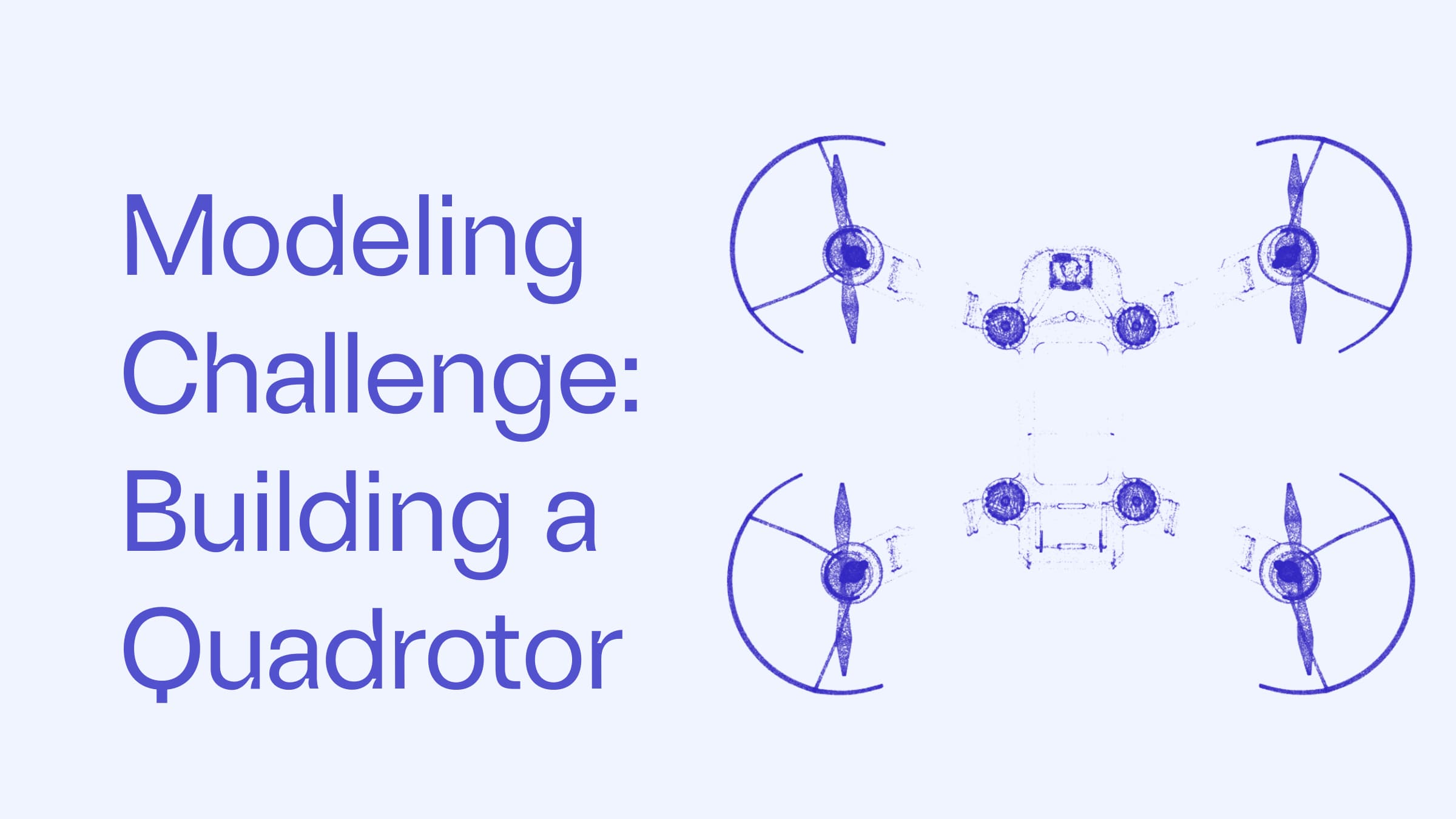

The Dyad Modeling Live Challenge is a weekly series where modeling and engineering problems are solved live using Dyad AI and its agentic AI capabilities. Our recent livestream featured a hands-on quadrotor modeling and simulation workflow.
The session began with a clean 6-DoF academic quadrotor model using a cascaded proportional - integral - derivative (PID) controller for position and attitude control. From this baseline, realism was added incrementally, allowing each modeling decision to be validated before moving forward.
Adding Real-World Dynamics
The model was extended to include:
Rotor drag, modeled as a velocity-dependent force, highlighting increased thrust demand and altered control behavior
Motor dynamics, including rotor spin directions and spin-up delays, revealing startup altitude drift and the need for controller adaptation
Wind disturbances using a Dryden wind gust model, introducing low-frequency stochastic turbulence while maintaining system stability
Throughout these steps, the Dyad agent automatically updated equations, adjusted controller parameters, resolved modeling conflicts, and validated results through simulation.
Visualization as a First-Class Citizen
A major highlight of the livestream was the emphasis on visual understanding:
Comparative plots for drag, motor dynamics, and wind effects
3D trajectory animations with cinematic camera angles
An interactive GUI with a time slider for exploring system behavior
The team also created animated SVG quadrotor icons, showing:
Rotor spin directions
Relative motor speeds
Clear visual cues for stability mechanisms
Attempts at mesh-based GLB/GLTF animations surfaced technical challenges, leading to a practical pivot toward simpler geometric models—an instructive reminder that clarity often beats complexity.
What the Dyad Agent Did Autonomously
Throughout the session, the Dyad agent demonstrated its core strengths:
Reading and understanding the model repository
Implementing physics-based equations correctly
Automatically validating models with tests
Resolving conflicting initialization equations
Adjusting controller logic as dynamics evolved
Generating simulations, plots, and animations
Live debugging such as restarting language servers and recompiling was handled seamlessly, reinforcing the practicality of agent-driven workflows.
Why It Matters
This live stream demonstrated how agent-driven modeling enables rapid iteration from academic prototypes to more realistic systems without sacrificing clarity or correctness. By automating model construction, testing, and visualization, Dyad allows engineers and researchers to focus on system behavior rather than implementation overhead.
The upcoming Dyad 2.0 release will further reduce interaction latency and expand agent capabilities, supporting more complex scenarios such as payload handling and mission-level simulations.
Check out the live stream here: