Modern modeling approach leveraging the "Single Source of Truth” for engineering design
If you look around you right now, you are almost completely surrounded by things that had to be engineered. From the massive power electronics powering the screens in our cities, to the structural design of skyscrapers, to the incredible complexity of a single modern car—the scale of human engineering is nothing short of awe-inspiring.
But behind every great machine is a mountain of complex math. Historically, engineers have had to act as translators, manually converting physical systems into mathematical code or block diagrams.
In our recent webinar, we challenged this paradigm. We looked at why the traditional way we model physical systems is fundamentally inadequate, how acausal modeling changes the game, and why the Dyad platform represents the future of engineering design.
What Do Engineers Actually Want From Their Tools?
When you boil it down, engineers don't want to spend their days doing tedious algebra or chasing down missing minus signs. They want to innovate. Ideally, an engineering tool should allow them to:
Build like LEGOs: Connect physical components together smoothly to see how they interact.
Eliminate arbitrary constraints: Avoid rigid rules about how components can be connected.
Create reusable models: Write a component once (using first principles or empirical data) and use it across multiple projects.
Avoid starting from scratch: Seamlessly swap out a single part or change a boundary condition without re-architecting the entire system.
Unfortunately, traditional causal modeling (block diagrams) forces engineers to do the exact opposite.
The Problem with Block Diagrams (Causal Modeling)
Mathematics is incredibly good at representing the universe, but it isn't the best way for a human to interact with a system.
Consider a typical block diagram containing integrators, step functions, and multipliers.
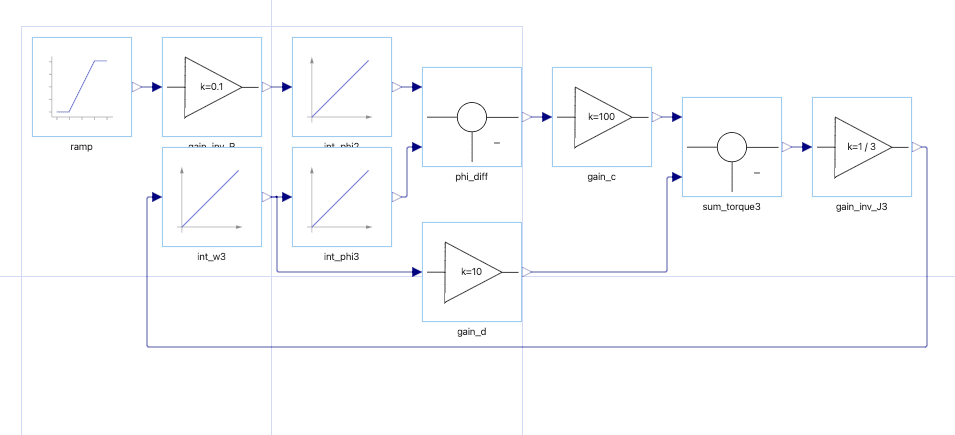
If someone asks you, "What physical system does this block diagram represent?" it’s almost impossible to tell just by looking at it.
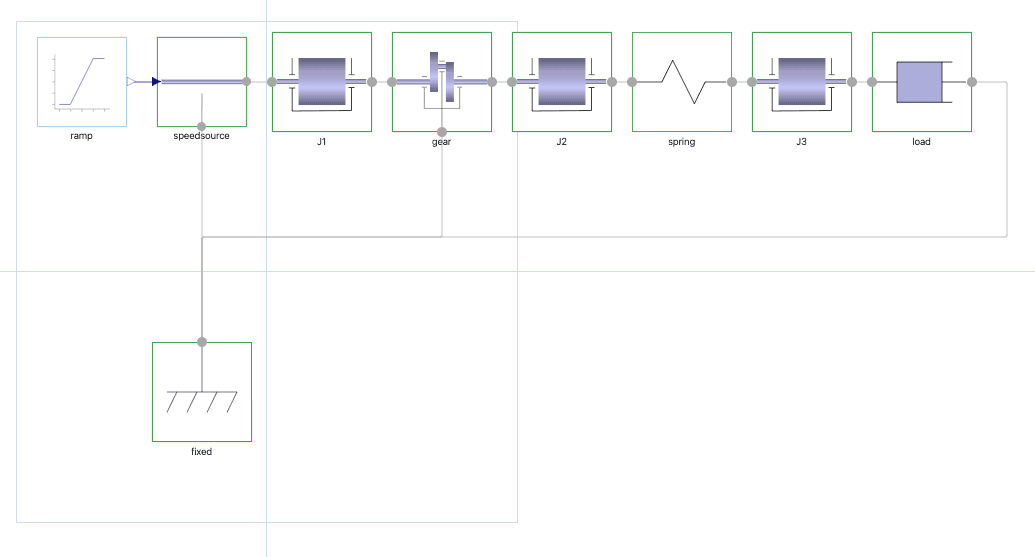
Now, look at a physical schematic of a mechanical system containing an inertia, a gear, a spring, and a damper.
Instinctively, any engineer knows exactly what that system is.
While both representations yield the exact same simulation results, causal block diagrams suffer from a fatal flaw: a lack of flexibility.
The "Small Change" Nightmare
In a causal system, you must define the inputs and outputs upfront. But what happens if you make a tiny change to your physical system?
Scenario A: You apply a torque to a rotational system and observe the velocity.
Scenario B: You switch the boundary condition to impose a prescribed velocity and observe the required torque.
Physically, the components haven't changed. But mathematically, switching the input and output completely flips the causality. In a traditional block diagram tool, this "small change" forces you to re-derive all your equations of motion from scratch and rebuild an entirely new block diagram. It is tedious, time-consuming, and highly error-prone.
Enter Acausal Modeling: The Single Source of Truth
Acausal modeling means modeling without making upfront assumptions about causality. You focus strictly on the physical relationships between variables, not on what is an "input" or an "output."
Take Ohm’s Law:
$$V = I \times R$$
Is voltage ($V$) the input and current ($I$) the output, or vice versa? The question itself is meaningless. Ohm's Law simply states a relationship. In an acausal language like Dyad, when you build a resistor, you don't have to choose. The component adapts automatically depending on how it is connected to the rest of the circuit.
The Power of Connectors
The magic of acausal modeling relies on defining physical connectors. In Dyad, an electrical pin defines two vital types of variables:
Potential (Across) Variables: The variable that drives the system (e.g., Voltage, $V$).
Flow (Through) Variables: The variable representing the actual "stuff" moving through the system, governed by conservation laws (e.g., Current, $I$).
Because the computer understands these underlying laws of the universe, it can handle the Math for you. You sketch the physical diagram, and the computer automatically derives the mathematical equations, generates the simulation code, and compiles it. The physical model becomes your Single Source of Truth.
Building Maintainable Engineering Software
Good modelers treat code like software. They follow the DRY (Don't Repeat Yourself) principle.
In Dyad, you can create a partial base model that outlines the shared physical traits of a system (like having two pins and an across-voltage variable), and then simply extend it to create specific components like resistors or capacitors.This declarative approach keeps your libraries lightweight, elegant, and perfectly maintainable.
Why Julia and Dyad are Next-Gen
During the interactive Q&A session, Michael shed light on what makes the Dyad platform uniquely powerful compared to legacy tools:
The Julia Architecture: Dyad sits on top of Julia packages like ModelingToolkit.jl and Symbolics.jl. This allows Dyad to perform blazing-fast symbolic manipulation, index reduction, and automatic differentiation.
Beyond Simulations: Because your model compiles into a clean, symbolic Julia representation, you aren't limited to just running a simulation. You can drop into a Julia REPL and write custom scripts for optimization loops, parameter sweeps, or eigenvalue analyses.
The Agentic Revolution: Dyad features an integrated AI Agent explicitly knowledgeable about engineering workflows, Julia, and the Dyad language. Want to generate a complex model from a research paper or a picture? The Dyad Agent can assist you in minutes, drastically reducing the time from concept to simulation.
What’s Next?
This webinar was just the beginning of a multi-part series. In our next session, we will dive deeper into multi-domain modeling, exploring how these concepts bridge the gap between electrical, mechanical, and thermal systems.
Stay tuned for part two, and if you haven't yet, head over to JuliaHub to explore Dyad for yourself!
Did you miss the live session? You can catch up on the full webinar here.
FAQs:
What is acausal modeling?
Acausal modeling is a physics-based approach where you describe the relationships between variables instead of defining fixed inputs and outputs. The simulation engine automatically
Why are traditional block-diagram models difficult to maintain?
Traditional block-diagram models require engineers to define signal flow and causality upfront. Acausal models describe the underlying physics, allowing the same model to work across multiple scenarios without restructuring. Even small design changes—such as changing an input into an output—can require engineers to derive new equations and rebuild large portions of the model, increasing engineering effort and the risk of errors.
What kinds of engineering problems benefit most from acausal modeling?
Acausal modeling is particularly valuable for: Multi-domain systems Electric vehicles Aerospace Robotics HVAC Energy systems Industrial equipment Medical devices where electrical, mechanical, hydraulic, thermal, and control systems interact.