
Julia Approaches The TIOBE Top 20: Julia reached No. 21 in the September 2026 TIOBE Index, placing it within striking distance of returning to the top 20. TIOBE highlighted Julia’s growing position across numerical computing, scientific computing, modeling, and data processing. While the index measures language popularity rather than technical quality, Julia’s latest ranking reflects increasing visibility for the language and its community. Find out more.
How an MIT Research Project Became a Global Programming Language: MIT News recently explored Julia’s evolution from a research project into a global programming language used by more than one million people. This story traces Julia’s origins at MIT, the creation of JuliaHub, and the language’s growing role in research and industry, from drug development and climate modeling to aircraft, robots, semiconductors, and complex engineering systems. The feature also looks at Dyad and the move toward agentic, physics-based engineering workflows. Read it here.
Pluto in VS Code—Notebooks Meet AI Agents: Pluto notebooks are known for reactivity and reproducibility, and now they can live directly inside VS Code. In this upcoming webinar, Panagiotis Georgakopoulos will introduce the Advanced Pluto extension and participants can learn how notebooks, a rich Julia terminal, and AI agents come together in one editor. Register here.
Dyad Is Getting More Agentic and 3.4 Is Coming Soon: Dyad 3.3 brought a smarter AI agent that better understands your projects, libraries, and models. The release also brought 3D multibody modeling and simulation to Dyad, with bodies, joints, cables, wheel dynamics, URDF import, and 3D rendering and animation. And there’s more to come. Dyad 3.4 is coming soon, with even more powerful agentic capabilities to make modeling and simulation more intuitive, intelligent, and collaborative.
From Physical Diagrams to Fast Simulation: Engineers naturally

think in components and connections, but the mathematics behind even a straightforward physical diagram can quickly become a large system of tightly coupled equations. In this new technical post, Dr. Michael Tiller explains how symbolic manipulation enables Dyad to turn intuitive physical models into efficient numerical simulations. The article follows a rotational mechanical system through alias elimination, equation sorting, block lower triangularization, index reduction, state selection, and tearing showing a workflow that lets engineers focus on the physics while Dyad handles the mathematical restructuring needed for fast and accurate simulation. Read more.
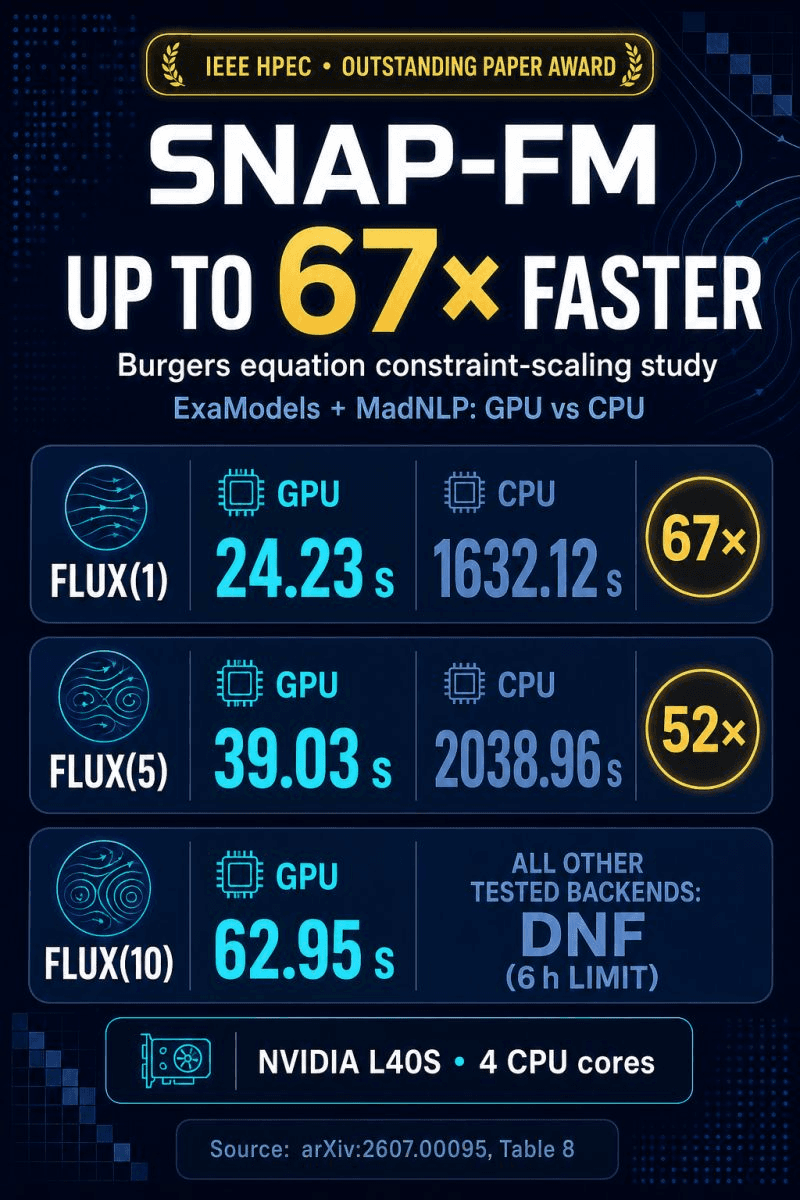
SNAP-FM Receives Outstanding Paper Award at IEEE HPEC: Generative models can serve as scalable alternatives to physical simulations, but their outputs are not guaranteed to satisfy conservation laws, boundary conditions, or nonlinear physical constraints. SNAP-FM addresses the computational cost of enforcing these constraints during inference by exploiting the block-sparse structure created by sample-wise batching and local PDE couplings. The work demonstrates how Julia’s composable ecosystem can bring together generative modeling, nonlinear optimization, sparse linear algebra, and GPU computing for scientific machine learning. Read it here.
Events and Conferences
JuliaCon Global 2026 Highlights: JuliaCon Global 2026 brought the community together in Mainz for a week of talks spanning scientific computing, engineering, AI, and developer tooling. JuliaHub speakers also presented new work across Dyad, SciML, agentic engineering, simulation, compiler technology, security, and Pluto notebooks in VS Code. The broader program showcased Julia’s extraordinary range—from aerospace and quantum computing to black-hole imaging.

JuliaHub and Boeing Keynote on Breaking the Non-Recurring Cost Curve Using Model Based Methodologies: Gary Mansouri, Boeing Technical Fellow, Chief Architect of Systems MBE, and Boeing Designated Expert, with Michael Tiller, Chris Rackauckas and Viral B. Shah
Beyond the Two-Language Problem: Next-Gen Engineering Design with Dyad + Julia in an AI world: Dr. Viral Shah, CEO and co-founder JuliaHub recently led a seminar at the Department of Mathematics, Institute of Chemical Technology (ICT) Mumbai, addressing students of Mathematics and Computing, as well as Machine Learning and Artificial Intelligence to talk about how Dyad closes the gap between the AI world and the realm of Physical AI grounded in laws of physics and simulation. Dr. Viral Shah explained how Dyad combines functionality from multiple siloed applications like Modelica, Simulink, Dymola, Amesim, Matlab, C++ etc. into a single coherent agentic system and makes it possible for a small team of engineers to build rapidly.
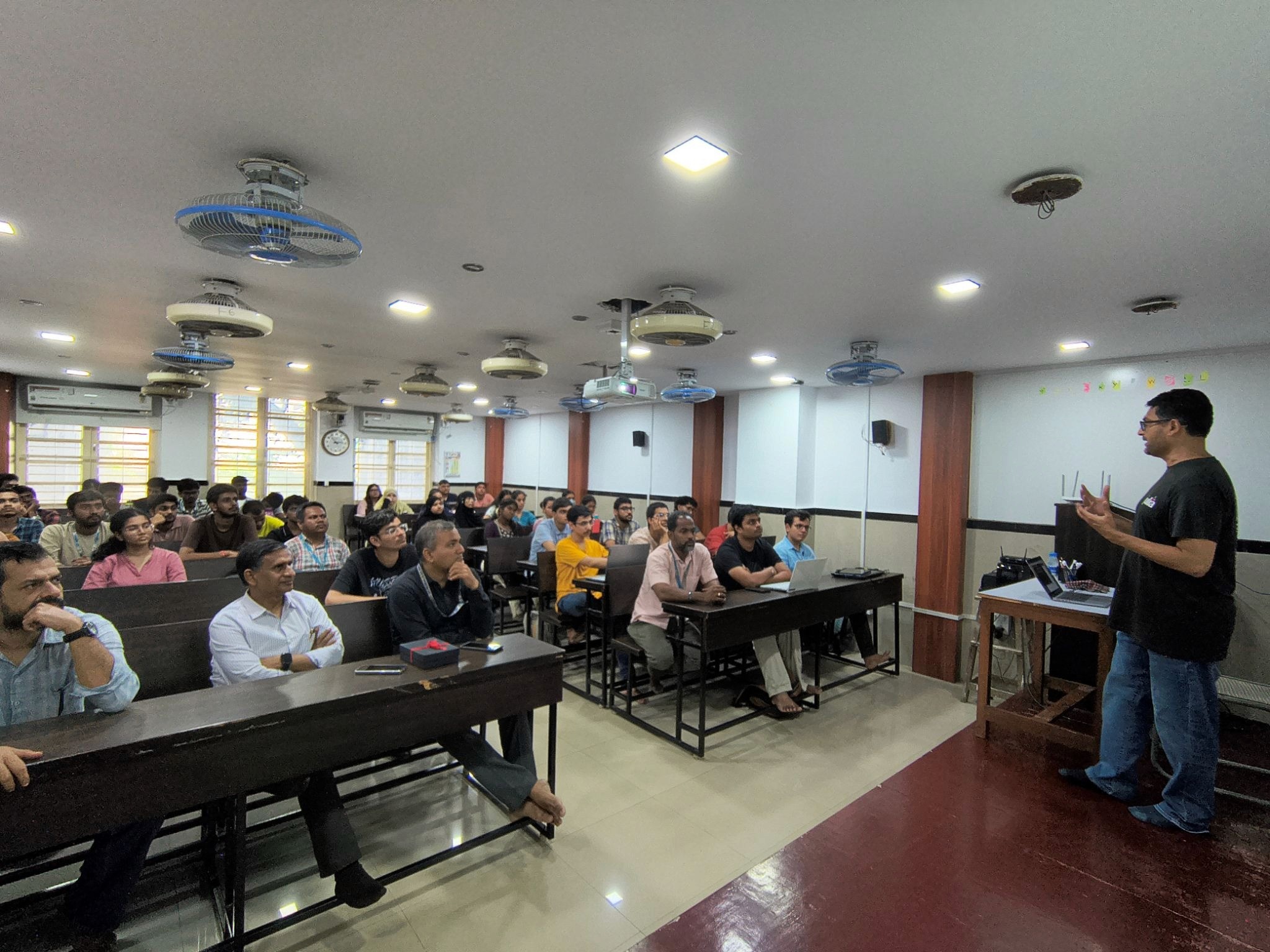
Dr. Viral Shah addressing the audience at ICT Mumbai
JuliaHub at ACoP 2026: JuliaHub will be at the 2026 American Conference on Pharmacometrics (ACoP 2026), taking place October 11–14, 2026, at the Gaylord National Resort & Convention Center in National Harbor (Oxon Hill), Maryland, USA. As one of the leading global events in pharmacometrics, ACoP brings together researchers, scientists, and industry leaders to advance quantitative approaches in drug development. If you’re attending, be sure to connect with the JuliaHub team to learn how Julia and Pumas are accelerating modeling, simulation, and pharmacometric innovation.
JuliaHub at American Modelica & FMI Conference 2026: JuliaHub is a Platinum Sponsor of the American Modelica and FMI Conference taking place at the Georgia Institute of Technology in the Aerospace Systems Design Laboratory from October 12–14, 2026. It is organized by NAMUG, the North American Modelica Users Group, in cooperation with the Modelica Association(NAMUG). Bringing together engineers, researchers, and industry leaders, NAMUG is a key forum for advancing modeling, simulation, and digital engineering. Join the JuliaHub team to discover how our Modelica-powered solutions are helping organizations build faster, more accurate simulations and accelerate innovation.
Insights and Recommendations
Agent Assisted Engineering: What It Actually Looks Like to Build a Model Live: What does an engineering agent actually look like when it is building and refining a model live? In this technical recap, Dr. Michael Tiller walks through the creation of an RLC circuit in Dyad Studio. Starting with an underspecified request, the Dyad Agent identifies missing requirements, derives component values, builds the model, runs the simulation, and verifies the results. Read the agent-assisted engineering recap and watch the webinar.
JuliaHub 26.4: Better Collaboration, Tighter Security, and Smoother Deployments: The latest release of JuliaHub brings much anticipated features like project history and branching, first-class deployments, local DyadRegistry hosting, global CVE roll-up and more. View the release blog.
CausalGraphs.jl: Representing Cause-Effect Relationships: CausalGraphs.jl is a new experimental Julia package for representing, analyzing, and visualizing cause-and-effect knowledge graphs. Developed by Julia community member Sebastian Celles, the project originated in work on measurement models, uncertainty analysis, and Ishikawa diagrams.
Recent JuliaHub Webinars: JuliaHub provides free one-hour Webinars on topics of interest to Julia users. Nearly 100 past Webinars are available online. Click here to watch.
This Month in Julia World: This Month in Julia World is a newsletter from Stefan Krastanov with up-to-date information about Julia events, new releases and more. Read it here.
Nouvelles Julia - Julia News en Français: Nouvelles Julia is a newsletter in French with the latest Julia news. Read it here.
Julia Dispatch Podcast: Julia Dispatch is a Julia podcast from Dr. Chris Rackauckas (JuliaHub VP of Modeling and Simulation) and Dr. Michael Tiemann. Watch it here.
JuliaHub Digital Twin Solutions and Consulting: We help enterprises build deployable and scalable solutions leveraging SciML to create highly accurate and trustworthy Digital Twins. Applications span asset health monitoring, optimization and predictive maintenance, process optimization, model-based control, design optimization, and internal or external simulation tools. We also offer consulting and technical support. Schedule a consultation with our solutions team to discuss your use case.
Careers at JuliaHub: JuliaHub is a fast-growing tech company with fully remote employees in 20 countries on 6 continents. Click here to learn more about exciting careers and internships with JuliaHub.
Julia Expertise Needed at University of Glasgow: Dr. Eric Silverman, Research Fellow at the University of Glasgow, seeks a Research Associate for a 5-year research project on computational modeling for public health using an agent-based modeling framework developed in Julia. Julia experience and a PhD are required for this position. Click here for more information and to apply.
Julia and JuliaHub in the News
TIOBE September Headline: Is Julia Going to Re-enter the Top 20?
TIOBE Index for September 2026: Python Drops Below 18% as Julia Nears Top 20
How an MIT Research Project Became a Global Programming Language
What Is Jupyter Notebook? A Beginner’s Guide for Data Scientists
Julia Blog Posts
JuliaHub 26.4: Better Collaboration, Tighter Security, and Smoother Deployments (Mridul Upadhyay)
Agent Assisted Engineering: What It Actually Looks Like to Build a Model Live (Dr. Michael Tiller)
Applying Julia’s Programming Philosophy To Application Architecture (Emma Boudreau)
Securing Infrastructure Resilience Against Climate Extremes: How Advanced Tech-Driven Disaster DX Redefines Landslide Early Warning (Sachiko Arvelius)
This Month in Julia World (Stefan Krastanov)
Nouvelles Julia (Pierre Navaro)
From Physical Diagrams to Fast Simulation: An Introduction to Symbolic Manipulation in Dyad (Michael Tiller)
cuTile.jl 1.0: Tile Windows, Atomics, and Sparse Views (Tim Besard)
CUDA.jl 6.3: Compiler Caching, a New cuDNN, and Dependent Launches (Tim Besard)
State of Julia’s GPU Ecosystem in 2026 (Guillaume Dalle)
Upcoming Julia and JuliaHub Events
Online: Pluto in VS Code - Notebook Meets AI Agents, Tuesday, September 15, 12:00 PM EDT.
Oxon Hill, Maryland, USA: American Conference on Pharmacometrics (ACoP 2026), October 11-14
Atlanta, USA: American Modelica & FMI Conference 2026, October 12-14
Contact Us: Please contact us if you want to:
Obtain pricing for Dyad and Julia consulting projects for your organization
Schedule Dyad or Julia training
Share information about exciting new Julia case studies or use cases
Partner with JuliaHub to organize a Julia event online or offline
About JuliaHub, Julia and Dyad
Dyad combines physics-based modeling with scientific machine learning(SciML) for mission-critical engineering. Dyad is fully agentic in its design, making it possible for engineers to carry out complex workflows through natural language interaction. Dyad integrates code, diagrams and agentic workflows in a seamless tool driving 10x productivity. Leveraging the Julia and the SciML ecosystem under the hood, Dyad also benefits from significantly higher performance compared to the competition, often being 100x faster at simulating complex physics. Teams leverage Dyad to build smarter, faster, and more reliable systems without compromising the rigor of traditional engineering, supporting use cases from predictive maintenance to real-time performance tuning and over-the-air updates. The Dyad tool powered by Julia and SciML is free to use. Get started here.
JuliaHub is a fast and easy-to-use code-to-cloud platform that accelerates the development and deployment of Julia programs. JuliaHub users include some of the most innovative companies in a range of industries including pharmaceuticals, automotive, energy, manufacturing, and semiconductor design and manufacture.
Julia is a high performance open source programming language that powers computationally demanding applications in modeling and simulation, drug development, design of multi-physical systems, electronic design automation, big data analytics, scientific machine learning and artificial intelligence. Julia solves the two language problem by combining the ease of use of Python and R with the speed of C++. Julia provides parallel computing capabilities out of the box and unlimited scalability with minimal effort. Julia has been downloaded by users at more than 10,000 companies and is used at more than 1,500 universities. Julia co-creators are the winners of the prestigious James H. Wilkinson Prize for Numerical Software and the Sidney Fernbach Award.