Dyad 2.0: What Agentic AI means for the Future of Computer Languages: JuliaHub is excited to announce the much-awaited Dyad v2.0.0 with power simulation and agentic AI capabilities. This release brings agentic AI and simulation together in a seamless environment, enabling models to act as interactive collaborators that propose formulations, generate experiments, test hypotheses, and autonomously refine results. Read more
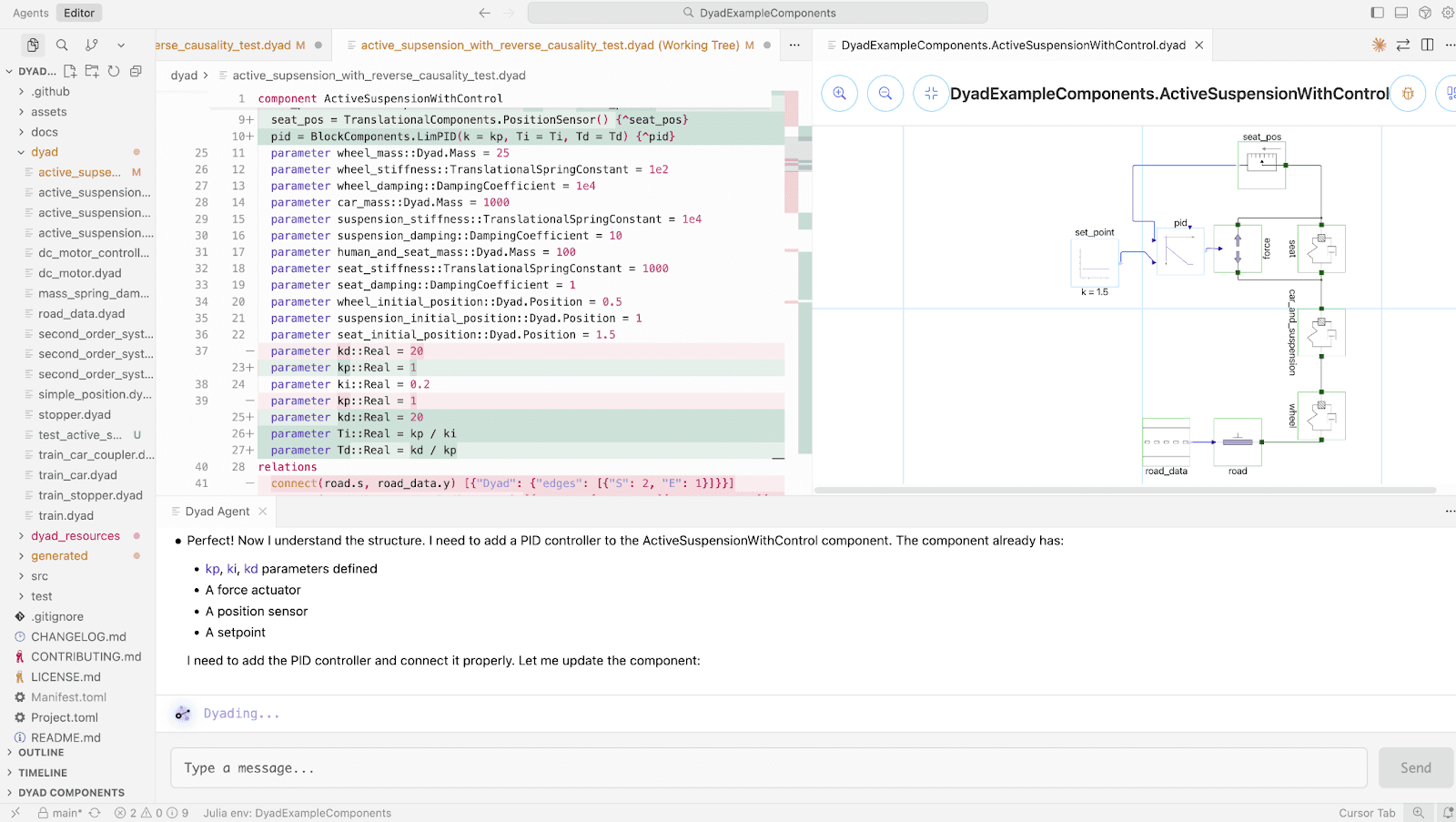
JuliaHub Launches Dyad AI: This announcement explores the role Dyad AI plays and how AI for Science is moving, by collaborating with engineers on models, behavior, and validation to close the loop between intent and verified performance. Read more
Agentic Dyad AI Modeling Livestream: Join our new weekly livestream where Dr. Chris Rackauckas builds real-world models with Dyad’s agentic AI. Bring your own challenge and watch models come together live, showcasing rapid model generation, iteration, and validation. Streaming every Friday at 10am EST on JuliaHub YouTube and @ChrisRackauckas Twitch, the series creates an open lab for engineers and researchers to explore agentic simulation firsthand. Watch the previous livestream episodes.
Dr. Viral Shah Writes for Design News: Agentic AI Transforms Hardware Engineering by Automating Model Construction & Validation: In a recent Design News feature, JuliaHub CEO Viral B. Shah explores how agentic AI can automate model construction, parameterization, and validation, while preserving the rigor of physics-based engineering. Platforms like Dyad treat models as structured, physics-aware objects, allowing AI agents to handle repetitive, error-prone setup work so engineers can focus on judgment, tradeoffs, and system design. Read more
JuliaHub Featured in Machine Design Magazine: Machine Design published an in-depth article by Brad Carman, Director of Consulting Services at JuliaHub, discussing how Scientific Machine Learning (SciML) is elevating predictive asset maintenance and optimization across manufacturing.
A “Who’s Who” Guide to Battery Modelling Software in 2026: Following the release of the 2025 Annual Battery Report by Volta Foundation, a 767-page compendium authored by over 120 battery experts, contributors Daniel Cogswell and Andrew Weng published a companion article offering a practical “who’s who” guide to battery modeling. Part 2 of the article, the duo share observations about the capabilities and ideal use cases for several common battery simulation software packages. This section talks about Dyad Batteries, an implementation of the physics-based Doyle–Fuller–Newman (DFN) model built in the Julia high-performance computing ecosystem. Fully compatible with Julia’s machine learning and optimization libraries, Dyad Batteries can be run via the JuliaHub Cloud Platform or directly as Julia code. Its standout advantage is speed, solving DFN models in milliseconds, orders of magnitude faster than many existing tools, making advanced battery modeling more accessible and scalable. Read the blog here.
Efficient Explicit Taylor ODE Integrators with Symbolic-Numeric Computing: New symbolic-numeric optimized Taylor ODE integrators are now delivering state-of-the-art performance for non-stiff problems, often surpassing traditional high-order explicit RK methods. These solvers combine Taylor-mode automatic differentiation, symbolic post-processing, and a novel order adaptivity algorithm to generate highly efficient integrators tailored to each problem. See the paper.
Breeze.jl: GPU-First Atmospheric Modeling in Julia: Breeze.jl is a new GPU_first, finite-volume atmospheric modeling framework written entirely in Julia. Built on the foundations of Oceananigans.jl, Breeze reuses familiar grids, fields, operators, solvers, and design principles, so it feels instantly recognizable and easy to learn. Breeze is focused on high-resolution applications, from ~10-meter large eddy simulations to kilometer-scale mesoscale modeling. Find out more.
JACC v1.0: Performance-Portable Parallelism in Julia: JACC v1.0 is the first stable release of a Julia package for performance-portable CPU and GPU programming, offering high-level APIs for arrays and parallel execution. . The project was developed under the leadership of Philip Fackler and incubated at Oak Ridge National Laboratory, with the goal of translating DOE HPC investments into practical, high-level scientific programming capabilities for the Julia ecosystem. See more.
Julia Gender Inclusive Invites Volunteers: This is an initiative dedicated to promoting gender diversity and inclusion across the wider Julia community. It welcomes individuals who identify as under-represented in terms of gender including women, non-binary people, trans people of all genders, and those exploring or questioning their gender. The initiative is inviting volunteers to help increase its JuliaCon presence, organize events/hackathons, and help with their social media.
Free Online Julia Webinars from JuliaHub: JuliaHub provides free one-hour Webinars led by JuliaHub staff and other experts. Space is limited and registration is required, so please sign up today!
Julia for Engineers: Introduction to Julia and Dyad with Dr. Ranjan Anantharaman, Wednesday February 25, 1-2 PM Eastern(US)
The Two Fundamental Paradigms of Systems Modeling with Dr. Ranjan Anantharaman, Wednesday March 11, 1-2 PM Eastern(US)
Julia for Engineers Part 2: Modeling Steady-State and Dynamic Systems with Dr. Ranjan Anantharaman, Wednesday March 18, 1-2 PM Eastern(US)
Recent JuliaHub Webinars: JuliaHub provides free one-hour Webinars on topics of interest to Julia users. Nearly 100 past Webinars are available online. Click here to watch.
This Month in Julia World: This Month in Julia World is a newsletter from Stefan Krastanov with up-to-date information about Julia events, new releases and more. Read it here.
Nouvelles Julia - Julia News en Français: Nouvelles Julia is a newsletter in French with the latest Julia news. Read it here.
JuliaCon Global 2026 — Call for Proposals Deadline: The Call for Proposals for JuliaCon Global 2026 is now open and closes on Feb 28, 2026 (23:59 CET). JuliaCon Global 2026 will take place in person in Mainz, Germany, from August 10–15, 2026. Talks will span beginner to advanced topics across industry and academia, offering a global stage to share your work with the Julia community. Submit your proposal here.
Methods and Applications of Scientific Machine Learning (SciML) Minisymposium: JuliaCon 2026 will have a minisymposium on “Methods and Applications of Scientific Machine Learning (SciML)” hosted by Chris Rackauckas. The purpose of this minisymposium is to share improved methods and applications of SciML to showcase the ever advancing ecosystem in Julia. Find out more and submit your proposal.
Geospatial Minisymposium: Anshul Singhvi, Maarten Pronk, and Felix Cremer will host a minisymposium on “Geospatial and GIS” at JuliaCon Global 2026. This minisymposium is meant for discussion of software projects in earth observation, geostatistics, geometry, or anything else geospatial/GIS related - with emphasis on how they can empower users to do interesting things. Submit your talks here.
Minisymposium: Computational Humanities & Social Sciences: JuliaCon will host a minisymposium on “Bringing Julia to the Computational Humanities and Social Sciences,” led by Alex Tantos, Julia Müller, and Axel Bohmann. The session invites researchers and practitioners exploring how Julia can support computational work across the humanities and social sciences, from text analysis and linguistics to cultural data and social research. Learn more.
Certification of Dynamical System Models Using End-to-End Distributionally-Robust Uncertainty Quantification: At AIAA SciTech, researchers presented OptimalUncertaintyQuantification.jl, a new Julia package for end-to-end, distributionally robust uncertainty quantification of both static and dynamical system models. The tool offers a symbolic, ergonomic interface for modeling systems while systematically incorporating data and prior knowledge about uncertainties. It automatically converts safety certification and verification problems into computationally tractable optimization problems, solved using integrated solvers. See the paper.
Julia4PDEs-2026: A 2-day workshop bringing together the Julia community working on partial differential equations (PDEs) will take place on March 26–27, 2026 at Vrije Universiteit Amsterdam. The event will feature keynotes from projects like Ferrite.jl, Gridap.jl, Trixi.jl, WaterLily.jl, and more, along with a hands-on demo of GalerkinToolkit.jl, a new multi-platform finite element library for Julia. Register here.
MultiFloats.jl v3.0 released: MultiFloats.jl is the world’s fastest library for extended-precision floating-point arithmetic with 128–256 bits (30–60 decimal digits).MultiFloats.jl v3.0 introduces new arithmetic algorithms that are simultaneously faster and more accurate than MultiFloats.jl v2.0. Read more.
New Blog Posts from SciML: SciML has published several new blog posts. You can read them here.
Blog Posts from Dr. Chris Rackauckas and Great Lakes Consulting: Read blog posts by JuliaHub VP of Modeling and Simulation Dr. Chris Rackauckas and Great Lakes Consulting Senior Julia Developer Steven Whitaker.
Julia Dispatch Podcast: Julia Dispatch is a Julia podcast from Dr. Chris Rackauckas (JuliaHub VP of Modeling and Simulation) and Dr. Michael Tiemann. Watch it here.
JuliaHub Digital Twin Solutions and Consulting: We help enterprises build deployable and scalable solutions leveraging SciML to create highly accurate and trustworthy Digital Twins. Applications span asset health monitoring, optimization and predictive maintenance, process optimization, model-based control, design optimization, and internal or external simulation tools. We also offer consulting and technical support. Schedule a consultation with our solutions team to discuss your use case.
Julia Expertise Needed at University of Glasgow: Dr. Eric Silverman, Research Fellow at the University of Glasgow, seeks a Research Associate for a 5-year research project on computational modeling for public health using an agent-based modeling framework developed in Julia. Julia experience and a PhD are required for this position. Click here for more information and to apply.
Julia Blog Posts
Scaling Workflows and Securing the Enterprise: What’s New in JuliaHub 25.10 (Mirdul Upadhyay)
Exploring the Julia Language in 2025: A New Step to Complement My Machine Learning Skills (Ernane Domingues)
JuliaHub at AIAA SciTech: Showcasing Dyad’s AI Agents for Engineering Intelligence (JuliaHub)
Featured in Machine Design: The Predictive Maintenance Breakthrough Manufacturing Needed (Jasmine Chokshi)
This Month in Julia World (Dec 2025) (Stefan Krastanov)
Nouvelles Julia (Jan 2026) (Pierre Navaro)
Julia and JuliaHub in the News
Design News: Agentic AI Transforms Hardware Engineering by Automating Model Construction & Validation
Machine Design: Is SciML the Predictive Maintenance Breakthrough Manufacturing Has Been Waiting For?
The Bowdoin Orient: Former NFL Lineman Urschel Talks Algorithms
Engineering.com: JuliaHub Introduces Dyad-based Framework for Physics Modeling
Manufacturing Tomorrow: JuliaHub Launches Dyad AI: The First Agentic Engineering Platform Built for Real-World Physics
DigitalEngineering247.com: JuliaHub Launches Dyad AI
Revolution In Simulation™: JuliaHub Launches Dyad AI: The First Agentic Engineering Platform Built for Real-World Physics
DailyCADCAM: JuliaHub Launches Dyad AI: The First Agentic Engineering Platform Built for Real-World Physics
Upcoming Julia and JuliaHub Events
Online: Julia for Engineers: Introduction to Julia and Dyad with Dr. Ranjan Anantharaman, Wednesday February 25,
Online: The Two Fundamental Paradigms of Systems Modeling with Dr. Ranjan Anantharaman, Wednesday March 11, 1-2 PM Eastern(US)
Online: Julia for Engineers Part 2: Modeling Steady-State and Dynamic Systems with Dr. Ranjan Anantharaman, Wednesday March 18, 1-2 PM Eastern(US)
Recent Julia and JuliaHub Events
Orlando, Florida: AIAA SciTech Forum and Exposition January 12-16, 2026
Las Vegas, Nevada: ASHRAE Winter Conference & AHR Expo January 31-Feb 4, 2026
Contact Us: Please contact us if you want to:
Obtain pricing for Dyad and Julia consulting projects for your organization
Schedule Dyad or Julia training
Share information about exciting new Julia case studies or use cases
Partner with JuliaHub to organize a Julia event online or offline
About JuliaHub, Julia and Dyad
Dyad combines physics-based modeling with scientific machine learning(SciML) for mission-critical engineering. Dyad is fully agentic in its design, making it possible for engineers to carry out complex workflows through natural language interaction. Dyad integrates code, diagrams and agentic workflows in a seamless tool driving 10x productivity. Leveraging the Julia and the SciML ecosystem under the hood, Dyad also benefits from significantly higher performance compared to the competition, often being 100x faster at simulating complex physics. Teams leverage Dyad to build smarter, faster, and more reliable systems without compromising the rigor of traditional engineering, supporting use cases from predictive maintenance to real-time performance tuning and over-the-air updates. Get started here.
JuliaHub is a fast and easy-to-use code-to-cloud platform that accelerates the development and deployment of Julia programs. JuliaHub users include some of the most innovative companies in a range of industries including pharmaceuticals, automotive, energy, manufacturing, and semiconductor design and manufacture.
Julia is a high performance open source programming language that powers computationally demanding applications in modeling and simulation, drug development, design of multi-physical systems, electronic design automation, big data analytics, scientific machine learning and artificial intelligence. Julia solves the two language problem by combining the ease of use of Python and R with the speed of C++. Julia provides parallel computing capabilities out of the box and unlimited scalability with minimal effort. Julia has been downloaded by users at more than 10,000 companies and is used at more than 1,500 universities. Julia co-creators are the winners of the prestigious James H. Wilkinson Prize for Numerical Software and the Sidney Fernbach Award.