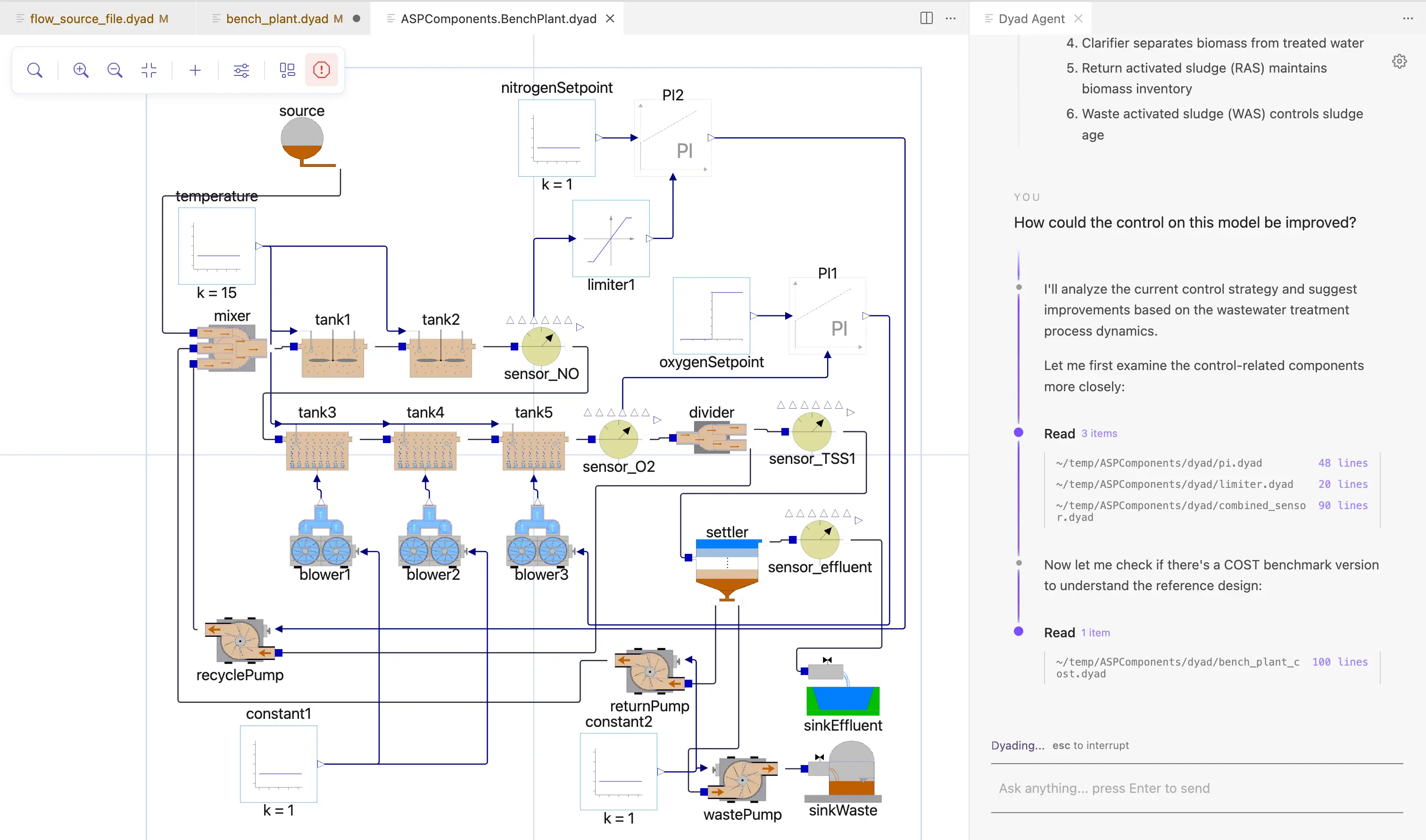
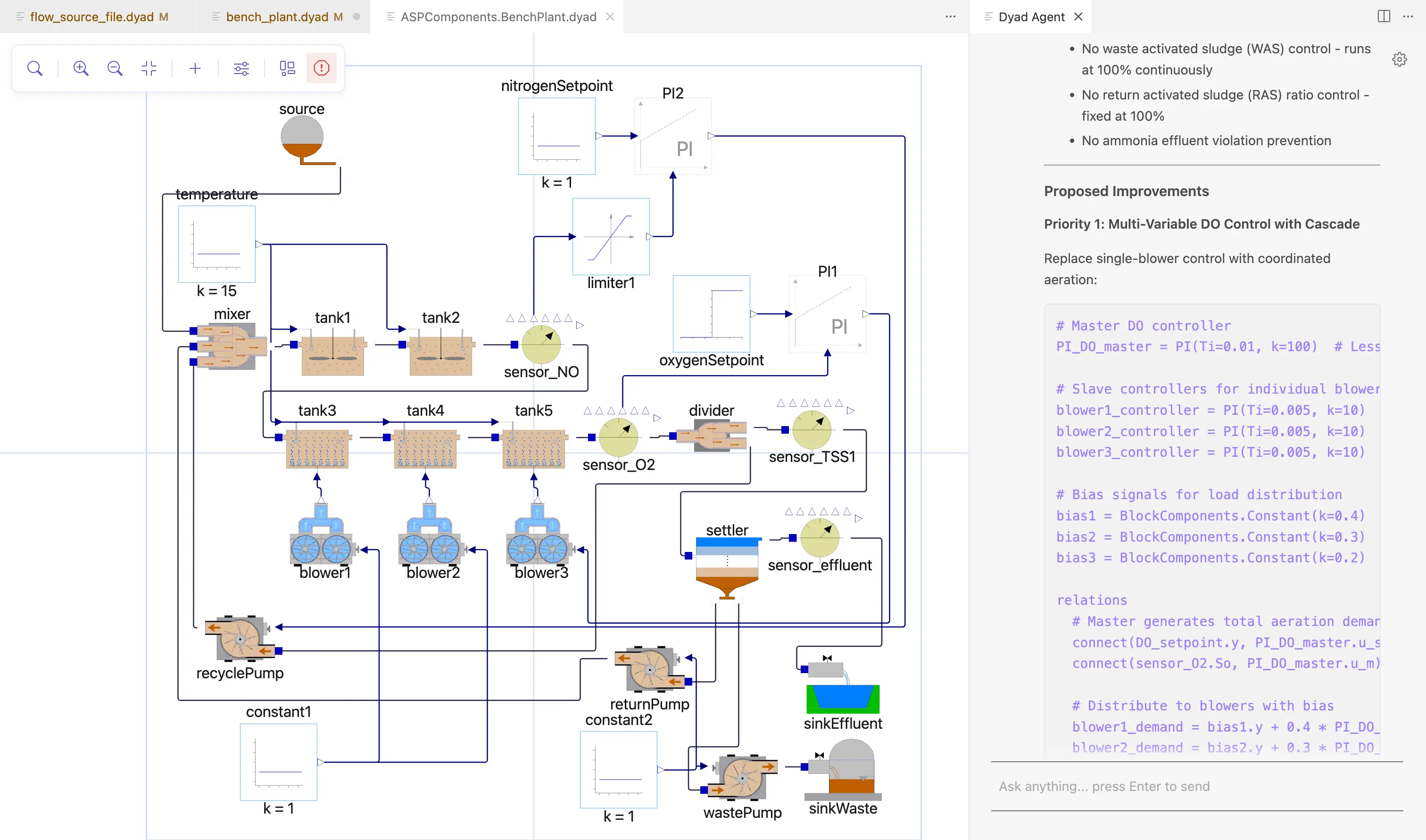
Announcing Dyad v.2.0.0 with Powerful Agentic AI Capabilities: JuliaHub is thrilled to announce the upcoming release of Dyad v2.0.0. The new release brings agentic AI and simulation together in a seamless environment, enabling models to act as interactive collaborators that propose formulations, generate experiments, test hypotheses, and autonomously refine results. By closing the loop between reasoning and simulation, Dyad accelerates engineering workflows and supports verified model development rather than manual trial-and-error. This is a major step toward AI-assisted modeling workflows. This release also introduces Dyad’s graphical interface, providing an intuitive user experience that supports both exploratory modeling and scalable engineering workflows.
Agentic Dyad AI Modeling Live-streaming: Join our new weekly live-stream where Dr. Chris Rackauckas builds real-world models with Dyad’s agentic AI. Participants can bring their own challenge and watch models come together live, showcasing rapid model generation, iteration, and validation. Streaming every Friday at 10am EST on JuliaHub YouTube and @ChrisRackauckas Twitch, the series creates an open lab for engineers and researchers to explore agentic simulation firsthand. Watch the first episode.
JuliaHub Partners with Synopsys to Integrate Dyad with Ansys TwinAI: JuliaHub announced the integration of Dyad into Ansys TwinAI. This partnership brings together JuliaHub’s expertise in AI-driven, physics-informed simulation with Synopsys digital twin technology to accelerate innovation and enhance the accuracy of hardware design and system optimization. “By integrating Dyad and JuliaHub’s SciML technology, TwinAI empowers engineers to build digital twins that evolve with data, bridging the gap between simulation and reality,” said Dr. Prith Banerjee, SVP at Synopsys.
Cooking a Turkey With Dyad Agentic AI: In a fun holiday experiment, engineers use Dyad’s agentic AI to build a discretized thermal model of a turkey and explore cooking strategies. The model simulates temperature dynamics across different heating settings, revealing how AI can optimize even a Thanksgiving dinner. The result is a playful demonstration of Dyad’s modeling capabilities and a glimpse into how agentic AI can rapidly iterate, analyze, and visualize real-world systems, from aerospace to holiday kitchens.
Watch the video:
Coffee Cup Thermal Model: Dyad’s AI agent built a thermal model of a coffee cup from just a schematic and a few sample plots. It interpreted the visuals, extracted relevant physics, generated executable code, and calibrated the model; all in real time. This demo shows how engineers can skip manual coding and go straight from sketches or diagrams to working simulations, saving time and unlocking faster iteration.
Advanced AI: Transforming Performance and Reliability: Scientific machine learning is key to re-engineering maintenance and reducing process emissions across water operations. This Water Industry Journal article shows how SciML enables predictive maintenance and emissions reduction without massive sensor deployments. Using physics-based models, utilities can anticipate pump failures, optimize energy use and cut nitrous oxide emissions. Early deployments report >90% prediction accuracy, signalling a major shift for AMP8 asset health. Read more.
JuliaHub at AIAA SciTech Forum: AIAA SciTech Forum will take place at Orlando, Florida from January 12-16. It is the world’s largest event for aerospace R&D, attracting more than 6,100 attendees from 48 countries. The 2026 theme is Breaking Barriers Together: Boundless Discovery, showcasing innovation, technical excellence, and global collaboration. JuliaHub will present Dyad’s Agentic AI capabilities at AIAA SciTech. Please contact us if you will be in attendance and would like to connect.
Uncovering Missing Physics with Dyad Model Discovery: JuliaHub Sales Engineer David Dinh has published a new blog post that explains how Dyad Model Discovery uncovers missing physics leveraging Universal Differential Equations(UDEs). This new tutorial teaches you how to insert a neural network component inside a Dyad model, extract symbolic representations of the learned dynamics, and how to make the most of acausal modeling with UDEs. Learn more.
Launching the Julia Security Working Group: A community effort to strengthen Julia’s security tooling is now officially underway. Join the new Julia Security Working Group (JLSEC) as they build SBOM tooling, package advisories, metadata analysis, and more. You can find them on slack at (#security-dev).
Julia 1.12.2 Released: Julia v1.12.2, the latest patch release, is now available via JuliaUp and julialang.org. It includes bug fixes, documentation cleanup, and performance improvements. Users on 1.12.0 or 1.12.1 are encouraged to upgrade. CI platforms now point “1.12” to this new release.
A Visual Log of Loading and Precompilation Times for Many Packages Over a Variety of Julia Versions: The new Julia Ecosystem Benchmarks Explorer gives interactive visual reports of package loading and precompilation (TTFX) across multiple Julia versions. Crowdsourced benchmarks, nightly runs, and crisp visualizations make it a valuable performance resource. The repository is updated daily.
Carlo.jl: high-performance Monte Carlo simulations in Julia: Lukas Weber’s talk from JuliaCon 2025 is available here. In this talk, Weber provides an overview of Carlo.jl and its features, sharing two perspectives for its usage - building Monte Carlo code from scratch using Carlo.jl and running existing implementations, calculating properties of a quantum magnet. Watch it here.
State of Julia: Lilith Hafner and Keno Fischer’s JuliaCon 2025 talk is available here. In this talk, Hafner and Fischer share updates on standalone executables, binding replacement, Pkg features, threading stabilization, and RISK-V support. In addition, they talk about AI’s impact on Julia development and open source relations. Watch it here.
Save the Date - JuliaCon 2026: JuliaCon 2026 will be held August 10-15, 2026 at Johannes Gutenberg University in Mainz, near Frankfurt. Click here for more information.
Free Online Julia Webinars from JuliaHub: JuliaHub provides free one-hour Webinars led by JuliaHub staff and other experts. Space is limited and registration is required, so please sign up today!
Causal vs. Acausal Modeling: Unlocking Flexibility in System Design with JuliaHub Sales Engineer David Dinh, Wednesday December 17, 1-2 PM Eastern(US)
JuliaC: A New Tool for Building Julia Binaries with Julia co-creator and JuliaHub founder Dr. Jeff Bezanson and Senior Engineer Kristoffer Carlsson on December 18, 1-2 PM Eastern(US)
Recent JuliaHub Webinars: JuliaHub provides free one-hour Webinars on topics of interest to Julia users. Nearly 100 past Webinars are available online. Click here to watch.
This Month in Julia World November 2025: This Month in Julia World is a newsletter from Stefan Krastanov with up-to-date information about Julia events, new releases and more. Click here to read.
Nouvelles Julia - Julia News en Français: Nouvelles Julia is a newsletter in French with the latest Julia news. Read it here.
Developing Surrogates for Epidemic Agent-Based Models via Scientific Machine Learning: This SciML preprint demonstrates how universal differential equations can be used to construct high-fidelity, explainable ODE surrogate models that accurately approximate the statistical outputs of agent-based epidemic simulations.
Heterogeneity in Responses to Ribosome-Targeting Antibiotics Mediated by Bacterial RNA Repair: A new Nature paper models Rtc-driven RNA repair and heteroresistance in E. coli using Julia’s ModelingToolkit and DifferentialEquations. Stability analyses with BifurcationKit reveal how variable rtc expression shapes translational capacity and influences antibiotic response. The work identifies targets that may help weaken resistance and improve treatment strategies. Read it here.
SwimmingIndividuals (SI) joins the NOAA Fisheries Integrated Toolbox: SwimmingIndividuals is a high-performance, Julia-based agent-based model for simulating marine ecosystems. Its hybrid CPU/GPU design scales to millions of organisms, each with physics-based vision, adaptive movement, and bioenergetics. The framework lets researchers test ecological theory, assess fisheries impacts, and model ecosystem responses to environmental change.
Learning the Unseen: Disturbance Modeling with Scientific Machine Learning in Julia: In a new technical tutorial, Dr. Fredrik Bagge Carlson shows how Scientific Machine Learning combines physics-based models with small neural networks to uncover hidden dynamics. Using a smart-home thermal model, the tutorial demonstrates how Dyad’s SciML workflow learns unmeasured solar heat disturbances by estimating cloud cover patterns directly from data. Find out more.
A Next-Generation Dynamic Programming Language Julia: Its Features and Applications in Biological Science: This review addresses the knowledge gap in biological science, highlighting Julia’s integration, key features (speed, parallel computing), and powerful packages. The review discusses how Julia outperforms rivals, paving the way for innovative biological discoveries. It aims to equip researchers with knowledge and tools to utilize Julia’s capabilities in biological science effectively and to demonstrate the gap. Read it here.
Fimbul: Fast, Flexible, Robust & Differentiable Geothermal Simulation in Julia: Fimbul, a Julia-based geothermal energy simulation toolbox is available through the Julia General Registry. Built on JutulDarcy, it offers parametrized geothermal models, tailored analysis and visualization, and specialized system simulation tools. Recently showcased at EAGE GET 2025, Fimbul highlights Julia’s growing role in next-generation geothermal modeling.
NonlinearSolve.jl: High-Performance and Robust Solvers for Systems of Nonlinear Equations in Julia: NonlinearSolve.jl delivers a high-performance, open-source solution to one of engineering’s core challenges, efficiently solving nonlinear equations at scale. Implemented natively in Julia, it offers a unified API, automatic algorithm selection, GPU-optimized static kernels for smaller problems, and advanced methods like sparse automatic differentiation and Jacobian-free Krylov approaches for large models. Benchmarking against established tools demonstrates strong robustness and efficiency, making NonlinearSolve.jl a powerful addition to the modeling and simulation toolkit for researchers and practitioners alike. Read more about it here.
New Blog Posts from SciML: SciML has published several new blog posts:
SciML Developer Chat Episode 1: Trimming, Base Splits, and Symbolics Precompilation
Fine-Grained Control in SciML: Introducing SciMLLogging and Enhanced Aliasing
New Blog Posts from Dr. Chris Rackauckas and Great Lakes Consulting: Several new blog posts have been published by JuliaHub VP of Modeling and Simulation Dr. Chris Rackauckas and Great Lakes Consulting Senior Julia Developer Steven Whitaker.
Julia Dispatch Podcast: Julia Dispatch is a Julia podcast from Dr. Chris Rackauckas (JuliaHub VP of Modeling and Simulation) and Dr. Michael Tiemann. Watch it here.
JuliaHub Digital Twin Solutions and Consulting: We help enterprises build deployable and scalable solutions leveraging SciML to create highly accurate and trustworthy Digital Twins. Applications span asset health monitoring, optimization and predictive maintenance, process optimization, model-based control, design optimization, and internal or external simulation tools. We also offer consulting and technical support. Schedule a consultation with our solutions team to discuss your use case.
Julia Expertise Needed at University of Glasgow: Dr. Eric Silverman, Research Fellow at the University of Glasgow, seeks a Research Associate for a 5-year research project on computational modeling for public health using an agent-based modeling framework developed in Julia. Julia experience and a PhD are required for this position. Click here for more information and to apply.
Julia Blog Posts
JuliaHub Partners with Synopsys to Power SciML-Based Digital Twins (JuliaHub)
This Month in Julia World (Nov 2025) (Stefan Krastanov)
Nouvelles Julia (October 2025) (Pierre Navaro)
Uncovering Missing Physics with Dyad Model Discovery (David Dinh)
Cooking a Turkey with Agentic AI: A Thanksgiving Experiment With Dyad (JuliaHub)
Announcing Raycore.jl: High-Performance Ray Tracing for CPU and GPU (Simon Danisch)
Simulating Raman Fiber Amplifiers in Julia: From Theory to High-Performance Code (Sarthak Dash)
The First Creator Skeleton (Emma Boudreau)
Julia Backend 2025: From Data to Dynamic Web Services (TechPreneur)
Setting up VSCodium for Python and Julia on Debian GNU/Linux (Vincenzo Brachetta)
Julia’s Static Compilation: An SVM Attempt on ImageNet. (Ningcong Chen)
10 Long-Term Development Tips (Emma Boudreau)
New Oliver Releases (Emma Boudreau)
Julia and JuliaHub in the News
Water Industry Journal: Advanced AI: Transforming Performance and Reliability
Stock Titan: JuliaHub Partners With Synopsys to Power SciML-Based Digital Twins
Quantum Zeitgeist: Julia Framework Optimizes Graph-Level Computations for Domain-Specific Applications, Enabling Dynamic Scheduling
Yahoo!Finance: JuliaHub Partners With Synopsys to Power SciML-Based Digital Twins
Quantum Zeitgeist: Classical Simulation of Two-Dimensional Transverse-Field Ising Model Advances Quantum Dynamics Understanding
Academia Mag: Top Trending Programming Languages in 2026
Simplilearn: 20 Machine Learning Tools for 2026
Upcoming Julia and JuliaHub Events
Online: Causal vs. Acausal Modeling: Unlocking Flexibility in System Design with JuliaHub Sales Engineer David Dinh, Wednesday December 17, 1-2 PM Eastern(US)
Online: JuliaC: A New Tool for Building Julia Binaries with Julia co-creator and JuliaHub founder Dr. Jeff Bezanson and Senior Engineer Kristoffer Carlsson on December 18, 1-2 PM Eastern(US)
Tokyo, Japan: JuliaLang Japan 2025, Saturday December 13, 2025
Orlando, Florida: AIAA SciTech Forum and Exposition January 12-16, 2026
Recent Julia and JuliaHub Events
Online: Control Systems Development in Julia with JuliaHub Sales Engineer Dr. Ranjan Anantharman, Tuesday November 18.
Online: Compilation of Julia Code for Deployment in Model-Based Engineering Workflows with JuliaHub Sales Engineer Dr. Ranjan Anantharman, November 20.
Online: Leveraging Neural Networks to Uncover Missing Physics with JuliaHub Sales Engineer David Dinh, December 03
Contact Us: Please contact us if you want to:
Obtain pricing for Dyad and Julia consulting projects for your organization
Schedule Dyad or Julia training
Share information about exciting new Julia case studies or use cases
Partner with JuliaHub to organize a Julia event online or offline
About JuliaHub, Julia and Dyad
Dyad combines physics-based modeling with scientific machine learning(SciML) for mission-critical engineering. Dyad is fully agentic in its design, making it possible for engineers to carry out complex workflows through natural language interaction. Dyad integrates code, diagrams and agentic workflows in a seamless tool driving 10x productivity. Leveraging the Julia and the SciML ecosystem under the hood, Dyad also benefits from significantly higher performance compared to the competition, often being 100x faster at simulating complex physics. Teams leverage Dyad to build smarter, faster, and more reliable systems without compromising the rigor of traditional engineering, supporting use cases from predictive maintenance to real-time performance tuning and over-the-air updates. Get started here.
JuliaHub is a fast and easy-to-use code-to-cloud platform that accelerates the development and deployment of Julia programs. JuliaHub users include some of the most innovative companies in a range of industries including pharmaceuticals, automotive, energy, manufacturing, and semiconductor design and manufacture.
Julia is a high performance open source programming language that powers computationally demanding applications in modeling and simulation, drug development, design of multi-physical systems, electronic design automation, big data analytics, scientific machine learning and artificial intelligence. Julia solves the two language problem by combining the ease of use of Python and R with the speed of C++. Julia provides parallel computing capabilities out of the box and unlimited scalability with minimal effort. Julia has been downloaded by users at more than 10,000 companies and is used at more than 1,500 universities. Julia co-creators are the winners of the prestigious James H. Wilkinson Prize for Numerical Software and the Sidney Fernbach Award.